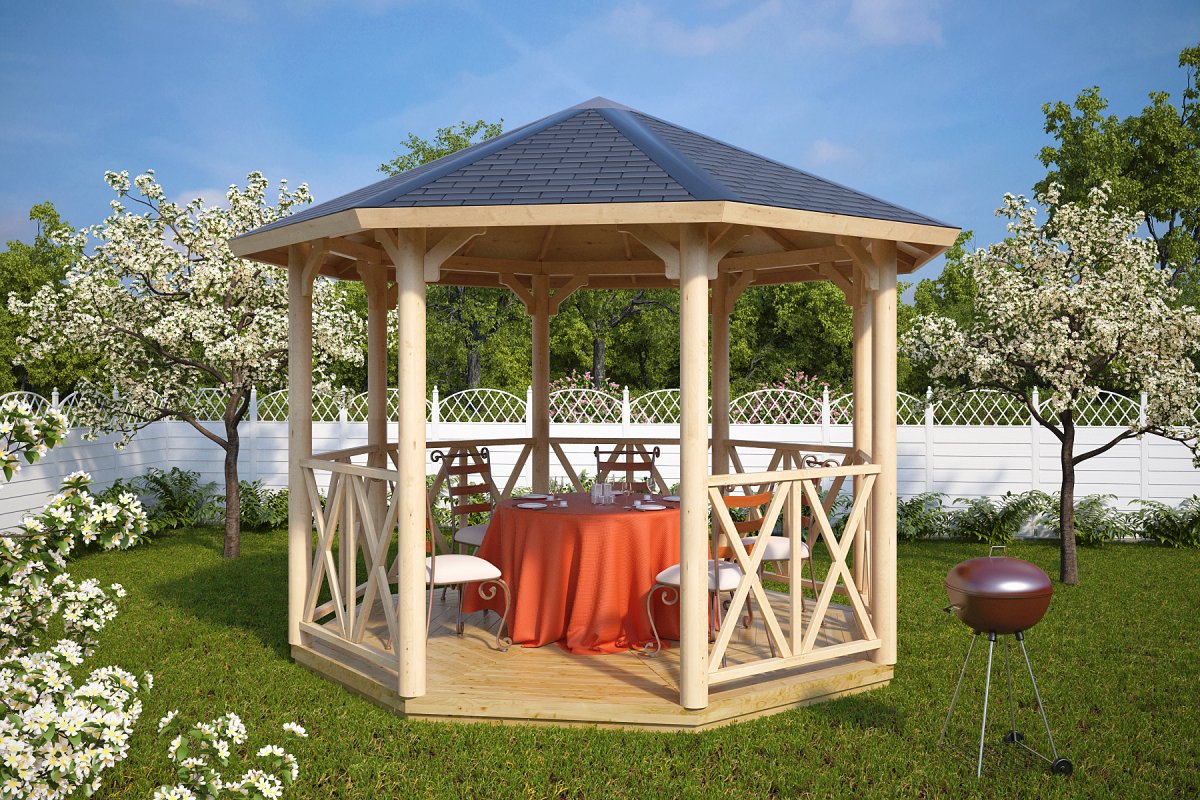
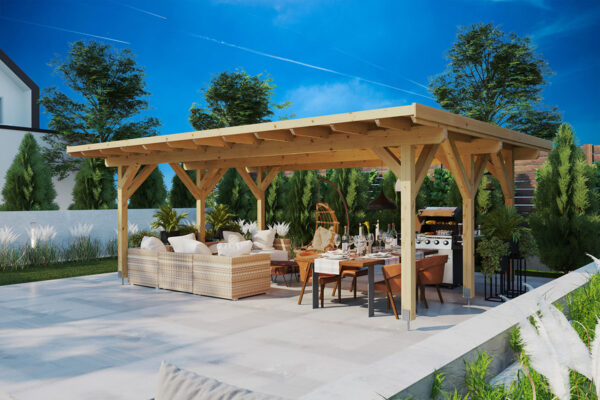
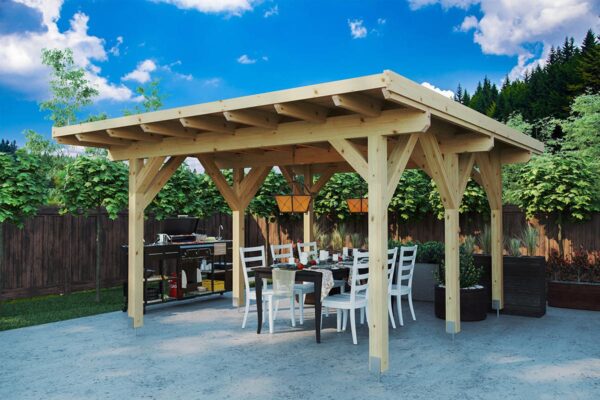
The secret to decorating a wooden gazebo is working in deliberate stages: map out your table and seating first, introduce textiles and lighting next, and finish with climbing plants. However, there is one crucial rule to keep in mind: always treat the timber first. Applying stains, oils, or protective sealants while the gazebo is completely empty will save you countless headaches down the road. Trying to treat timber around bulky furniture and established vines is an exercise in frustration.
These seven ideas follow that logical sequence, highlighting essential dimensions, styling tips, and common pitfalls to avoid.
| Step | What It Solves |
|---|---|
| 1. Dining area dimensions | Ensuring tables, chairs, and walkways fit without crowding |
| 2. Outdoor curtains and textiles | Providing shade, privacy, and weather resistance |
| 3. Warm, safe lighting | Creating evening ambiance without electrical hazards |
| 4. Climbers and greenery | Adding natural shade, color, and fragrance |
| 5. Timber finishes and stains | Protecting bare wood from silvering and weather damage |
| 6. Dedicated barbecue setup | Grilling safely without smoke buildup or fire risks |
| 7. Mosquito protection | Keeping outdoor dinners bite-free late into the night |
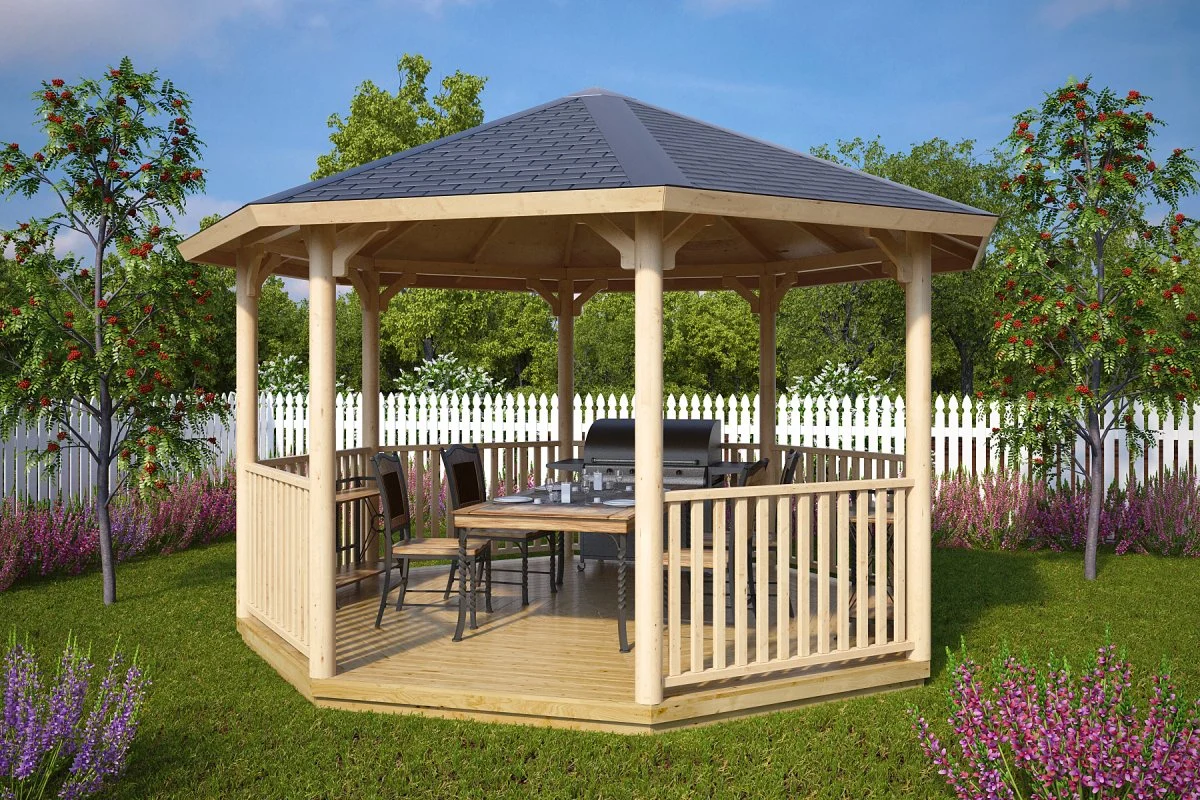
According to IKEA planning guidelines, you should leave 110 to 120 cm of clearance from the edge of the table to comfortably push back a chair and walk past. If you need a primary walkway behind seated diners, increase that clearance to 130–150 cm. For sizing, a 90 to 120 cm round table comfortably seats 2 to 4 people, while a 180 to 240 cm rectangular table is ideal for groups of 6 to 8.
Doing the math ahead of time prevents cramped layouts. Take a 3.6 × 3.6 m gazebo built with 120 mm posts: once you account for the framework, you are left with roughly 3.35 m of usable interior clearance. Centering a 120 cm round table leaves about 1.08 m of clearance on either side—enough room to sit, but tight for anyone trying to squeeze behind an occupied chair. Downsizing to a 100 cm table frees up an extra 10 cm of breathing room all around. In a larger 4.4 × 4.4 m gazebo, a 180 cm rectangular table leaves a generous 1.2 m at each end, whereas a 240 cm table cuts that down to 0.9 m, making movement awkward.
If you already have outdoor dining furniture, measure your set before ordering your structure and select a gazebo footprint that fits. Alternatively, consider built-in options: models like the Lotte L feature integrated timber flooring, a central dining table, and circular perimeter bench seating designed to comfortably host up to 14 guests.
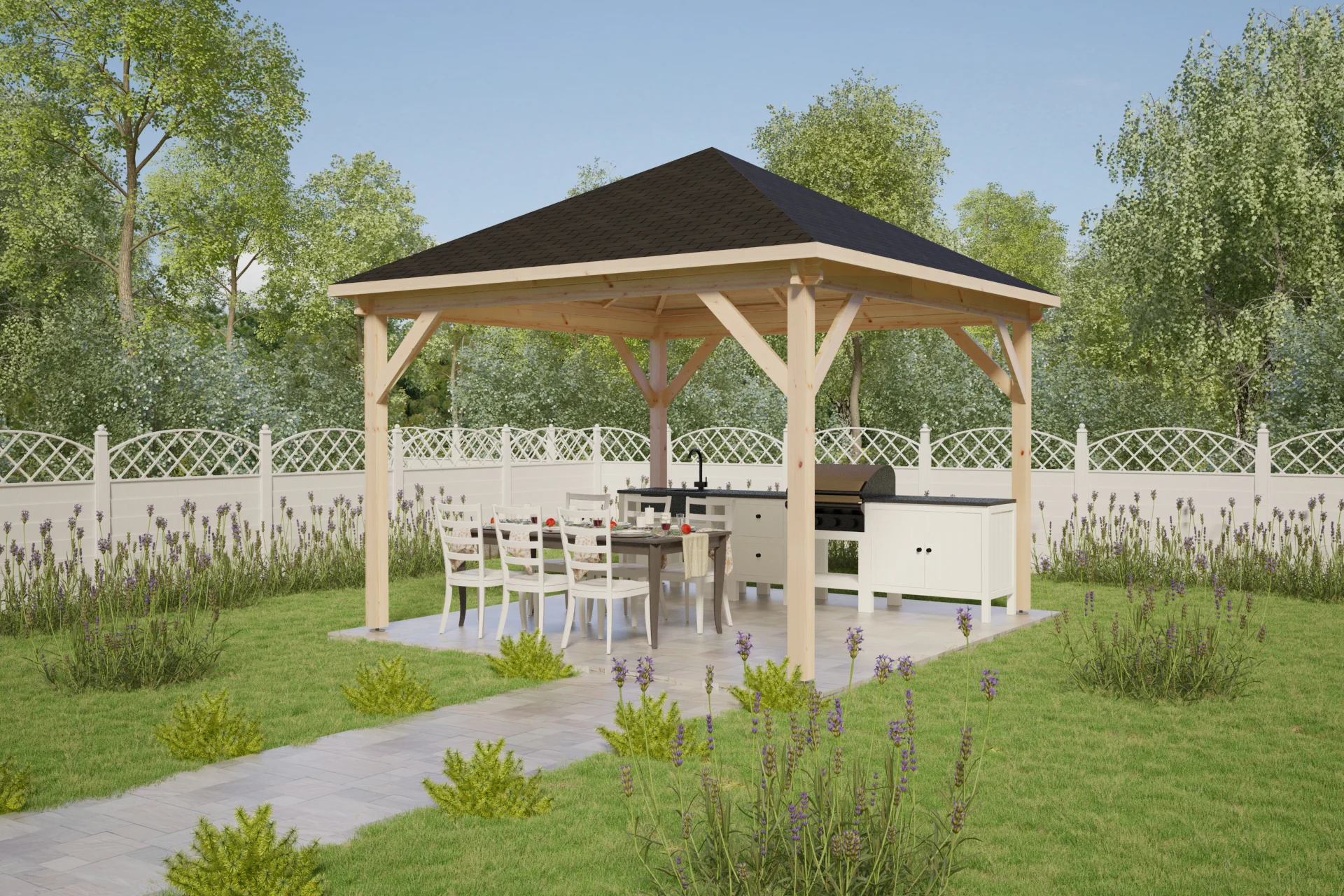
Gazebos from Casetas de Jardín 24 range from 3 × 3 m to 4.4 × 4.4 m, engineered with heavy-duty 120 mm posts. Choose a gazebo size that fits your dining table—not the other way around.
Backed by over 20 years of craftsmanship and a 5-year factory warranty.
Draped side curtains add an elegant resort feel while blocking harsh afternoon sun and buffering stiff breezes. Opt for solution-dyed acrylic fabrics: because the color pigments are infused directly into the fiber core during production, they resist UV fading significantly better than piece-dyed materials. Be skeptical of fabrics marketed as fully “waterproof.” Performance fabric specialist Sunbrella notes that premium outdoor textiles are engineered to be water-repellent, breathable, and quick-drying, rather than entirely impermeable.
Keeping outdoor fabrics in top condition takes minimal effort. Hose them down with clean water monthly, spot-clean stains with mild soap and lukewarm water, and always allow them to air-dry thoroughly. It is best to take curtains down ahead of severe storms and ensure they are bone-dry before storing them away. Putting damp cushions into storage is the number-one cause of mildew, as trapped moisture quickly breeds spores within the fabric weave.
If you plan to install a shade sail inside or adjacent to the frame, look for an Ultraviolet Effectiveness (UVE) rating of at least 80%. Australian health authorities recommend this baseline for shade structures; higher ratings offer superior defense against UV radiation.
To give your gazebo a cozy, welcoming evening glow, select bulbs with a warm color temperature between 2700 K and 3000 K. This warm-white spectrum is standard across architectural garden lighting, illuminating your space clearly without the cold, clinical glare of commercial floodlights.
Before hanging festoon lights, fairy lights, or pendant fixtures, check their Ingress Protection (IP) rating:
When installing solar-powered string lights, a common mistake is mounting the small solar collector under the gazebo roof. The panel needs unobstructed sunlight to charge during the day, so position it on an exterior beam or nearby post, verifying that the lead cable is long enough. If you prefer hardwired 230 V electrical fixtures, heaters, or outlets, always hire a licensed electrician.
Climbing vines soften structural lines, provide natural canopy shade, and fill the evening air with scent. However, they also require ongoing care. Here are the best varieties to consider:
Always plant climbers slightly away from the timber posts. The Royal Horticultural Society (RHS) recommends planting climbers 45–60 cm away from the base of walls to avoid the rain-shadow dry zone, and the same principle applies to gazebo posts. Train shoots along tensioned guide wires rather than allowing them to wind behind timber fascias or shingle edges, where they can lift roofing materials over time.
If you are deciding between an open-slat structure and an enclosed canopy for training plants, check our guide on what a pergola is and how it differs from a gazebo.
The Dora and Henley XL pergolas provide 20 to 30 m² of overhead coverage, built with durable glulam timber frames. Their 2.2 m uprights can easily be trimmed to achieve your preferred height.
🏠 Explore pergolas and gazebos
Includes free delivery and a 5-year factory warranty.
Unfinished timber exposed to direct sunlight will naturally weather to a dull silver-gray within a few seasons. Applying a tinted exterior wood oil or stain with UV-blocking pigments protects the wood fibers from solar degradation while highlighting the natural grain with tones like oak, teak, or cedar.
A microporous wood stain or penetrating exterior oil is ideal because it allows the wood to breathe and release internal moisture without blistering. For new, untreated wood, manufacturers like Osmo recommend applying two coats. Routine maintenance is straightforward: a single maintenance coat over a clean, dry surface—no heavy sanding required—is typically all that is needed. Reapplication intervals vary from 2 to 5 years depending on sun and moisture exposure, but the best rule of thumb is to inspect your gazebo each spring and apply a refresher coat as soon as water stops beading on the surface.
For product recommendations, consult our guide to the best wood stains and varnishes for log cabins. If you prefer an opaque painted look, take inspiration from these painted log cabin color ideas.
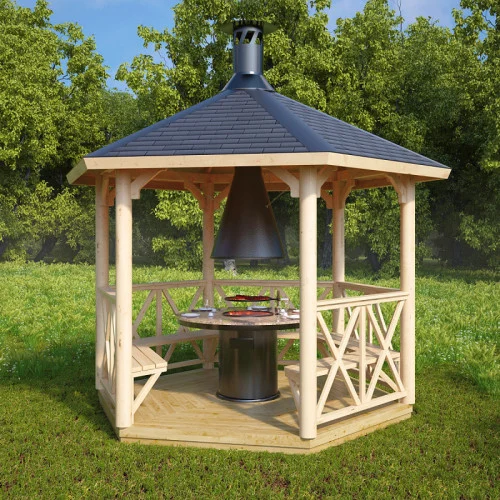
When setting up a grill station near a wooden structure, safety must dictate your layout. Fire services, including the Dortmund Fire Department, warn that solid roofs trap heat and smoke, noting that only electric grills should ever be used beneath an enclosed canopy due to the acute risk of carbon monoxide poisoning. The Buckinghamshire Fire & Rescue Service strongly advises against operating barbecues under canopies or awnings, while Berlin fire authorities reiterate that charcoal and gas grills belong exclusively outdoors in open air.
To grill safely around a gazebo, choose one of these three solutions:
Required clearances vary by region: municipal fire codes in Melilla require a minimum distance of 3 meters from combustible materials, whereas German fire departments recommend 1 meter for gas grills and up to 5 meters for open-charcoal models. Always review your grill manufacturer’s manual and observe local fire safety codes. To see purpose-built setups, explore our range of barbecue huts and grill cabins.
Placing pots of citronella grass, lavender, or mint around your gazebo may look and smell pleasant, but it will not keep pests away. Horticultural specialists at UF/IFAS point out that live plants do very little to repel mosquitoes on their own; their active aromatic oils must be crushed, extracted, or vaporized to have any measurable deterrent effect.
What reliably works is physical protection and airflow. Installing fine mesh screens along openings—as recommended by the CDC for outdoor living areas—blocks bugs mechanically. Generating airflow is equally effective: research on mosquito flight behavior shows that moving air disrupts their navigation and disperses the carbon dioxide plumes they use to track hosts. Mounting an outdoor-rated ceiling fan or positioning an oscillating floor fan inside the gazebo significantly cuts down on bites while keeping your guests cool.
Transforming a wooden gazebo into an inviting outdoor living room is all about getting the fundamentals right before adding the finishing touches. Calculate your table clearances and pathways first, seal the raw timber before hanging anything, select breathable outdoor textiles, and choose 2700–3000 K lighting with the right moisture rating. When it comes to cooking, prioritize safety: keep open-flame grills outside the structure unless you are using a dedicated grill cabin with a chimney.
Allow 110 to 120 cm of space between the table edge and the gazebo posts to pull out chairs and move around comfortably. If the area serves as a primary walkway behind seated guests, plan for 130 to 150 cm of clearance.
Warm-white lighting in the 2700–3000 K range provides the most flattering, relaxing ambiance. Fixtures with an IP44 rating are suitable for sheltered ceilings protected from wind-blown rain, while an IP65 rating is recommended for fixtures exposed to driving weather. If using solar lights, ensure the charging panel sits outside in direct sun.
No. Fire departments strongly advise against running gas or charcoal grills beneath solid canopies because trapped smoke and invisible carbon monoxide present severe health and fire risks. Stick to electric grills under the roof, move your barbecue out into the open garden, or invest in a purpose-built barbecue gazebo equipped with a hood and chimney flue.