When it comes to timber homes in Spain, the most serious biological threats are wood-destroying insects: primarily termites and woodworm. Because these pests target damp or untreated timber, your most reliable defence is simple: keep the wood’s moisture content below 20%, raise the structure off the ground, provide plenty of ventilation, and protect external surfaces with a breathable, microporous wood stain.
Nordic spruce has naturally low insect resistance. Far from being a structural flaw, this is simply a characteristic of the species—one that is straightforward to manage with proper foundation design and routine upkeep. This guide explains how to identify common pests by their telltale signs, what Spain’s Technical Building Code (CTE) requires, how to stop infestations before they start, and when it is time to call in a specialist.
| What You See | Likely Culprit | Urgency |
|---|---|---|
| Pencil-thick mud tubes running up foundations or walls | Subterranean termite | High: call a pest professional immediately |
| Piles of tiny pellets beneath timber or kick-out holes | Drywood termite | High |
| 1–2 mm round holes accompanied by fine, pale bore dust | Common furniture beetle (Anobium punctatum, small woodworm) | Medium: determine whether the infestation is active |
| Large oval exit holes in roof beams | House longhorn beetle (Hylotrupes bajulus, large woodworm) | High: can compromise structural integrity |
| Clean, smooth galleries alongside coarse sawdust | Carpenter ant | Medium: find and fix the underlying moisture issue |
| Clean, round holes (approx. 12 mm across) with sawdust below | Carpenter bee | Low to medium |
Two native subterranean termite species are widespread across mainland Spain: Reticulitermes grassei and R. banyulensis. A 2025 study confirmed that their range covers nearly the entire Iberian Peninsula, thriving in both rural landscapes and urban centres. Only high-altitude mountain peaks and arid extremes, such as the Tabernas Desert in Almería, remain virtually free of them.
Subterranean termites nest underground and build sheltered mud tubes—made of earth, saliva, and excrement—to travel safely up into structural timbers. Because they require constant humidity, direct wood-to-ground contact is the single greatest risk factor for any timber building. Meanwhile, in the Canary Islands, the invasive eastern subterranean termite (Reticulitermes flavipes) was detected in Tenerife in 2009 and subsequently in Lanzarote. Spain’s Ministry for Ecological Transition (MITECO) stresses that moving infested wood and soil is the main driver of its spread. In affected areas, never move untreated timber, landscape mulch, or construction waste between properties.
Unlike their subterranean cousins, drywood termites do not need contact with the soil. Research by the University of Valladolid and the Polytechnic University of Madrid highlights two primary species found in Spain:
The most reliable sign of drywood termites is the presence of tiny, six-sided faecal pellets (frass) beneath the wood, alongside minute kick-out holes through which workers eject waste. If you spot these pellets on a windowsill or floor, collect a small sample before sweeping them up to help an exterminator identify the species.
The common furniture beetle (Anobium punctatum, often referred to simply as woodworm) targets timber with a moisture content above 16%, according to historic building conservation research. As a result, infestations almost exclusively develop in poorly ventilated spaces or areas affected by trapped damp. It leaves round 1–2 mm exit flight holes and fine, gritty frass. According to the Society for the Protection of Ancient Buildings (SPAB), an infestation is active when the edges of exit holes are sharp and clean, exposing fresh, light-coloured wood dust inside.
The house longhorn beetle (Hylotrupes bajulus) poses a far greater structural hazard. Its larvae feed on the sapwood of softwoods—frequently attacking warm roof spaces where summer heat encourages breeding—and can survive in wood with moisture levels as low as 8–10%. Their exit holes are noticeably larger, typically oval, and measure roughly 6 to 10 mm across.
The powderpost beetle (Lyctus) is another notorious wood-boring pest, but it feeds exclusively on starchy hardwoods. If your cabin is constructed from softwood such as spruce or pine, Lyctus poses no threat.
A timber building can stand for decades when the foundation, ventilation, and protective treatments are executed properly from day one. We craft our buildings from select Nordic spruce and guide you from model selection through to assembly.
Manufacturer with over 20 years of experience and a 5-year warranty.
Under European standard EN 350, the heartwood of Norway spruce (Picea abies) is rated Durability Class 4 (slightly durable) against wood-decay fungi. According to technical data from Proholz, it is classified as susceptible to dry-wood borers and termites. Sapwood across all timber species is non-durable by default.
Spain’s CTE (DB SE-M) highlights a crucial practical consideration: spruce and fir are naturally refractory, meaning they resist chemical penetration unless treated under high-pressure industrial cycles. Consequently, applying a superficial brush-on treatment over damp timber offers virtually no long-term protection against determined pests.
This does not mean spruce is unsuitable for construction—it simply means durability relies on sensible detailing and moisture control. On our models, the ground-contact foundation bearers and terrace decking are pressure-treated at the factory, while the interlocking wall logs are supplied as raw timber that requires finishing immediately after assembly.
Thermal modification dramatically improves resistance to fungal rot by reducing the wood’s equilibrium moisture content below 20%—the minimum threshold required for decay fungi to grow (ThermoWood Handbook 2025). However, the handbook notes that field studies show thermal modification does not provide reliable resistance against termites. If you build in a termite-prone region, thermally modified timber cannot replace physical ground barriers and disciplined moisture management.
Pest prevention comes down to removing two vital conditions: moisture and physical access. Prioritise these construction details in order of importance:
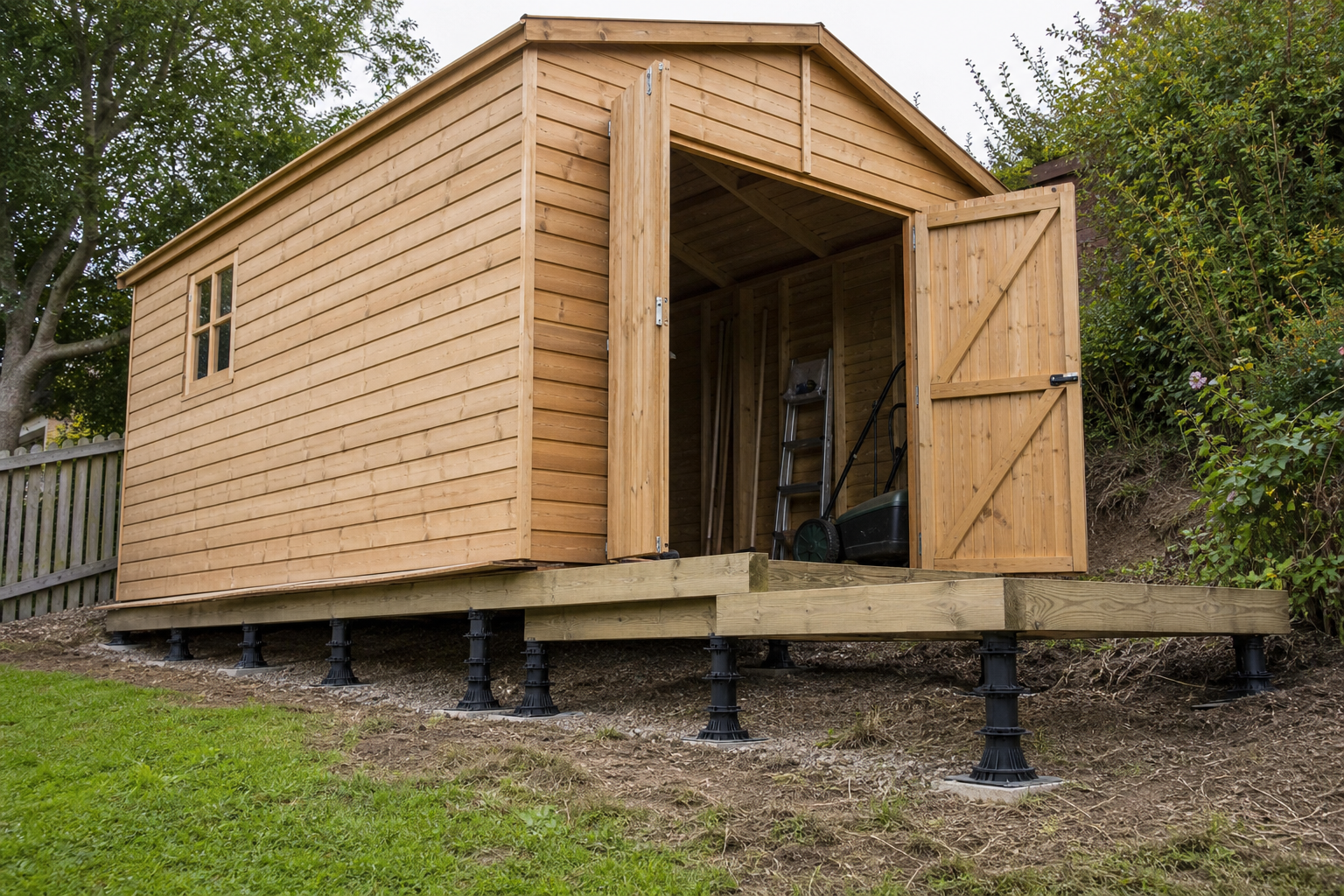
Adjustable pedestals, like those shown above, elevate the base framework above the concrete slab to promote continuous airflow underneath. For a closer look at managing humidity, our garden shed moisture guide covers diagnosing condensation, rain leaks, and rising damp.
Common mistake: Applying paints, sealers, or stains over damp wood without tackling the water source first. A surface finish might hide problem areas for a few months, but trapping moisture inside creates an ideal incubator for woodworm and fungal decay.
A quick inspection every spring and autumn will catch almost any pest activity before structural harm occurs:
Take close-up photos of any suspicious holes with a ruler alongside for scale, noting the date. If fresh sawdust appears by your next check, the infestation is active. For seasonal advice, read our full timber house maintenance guide.
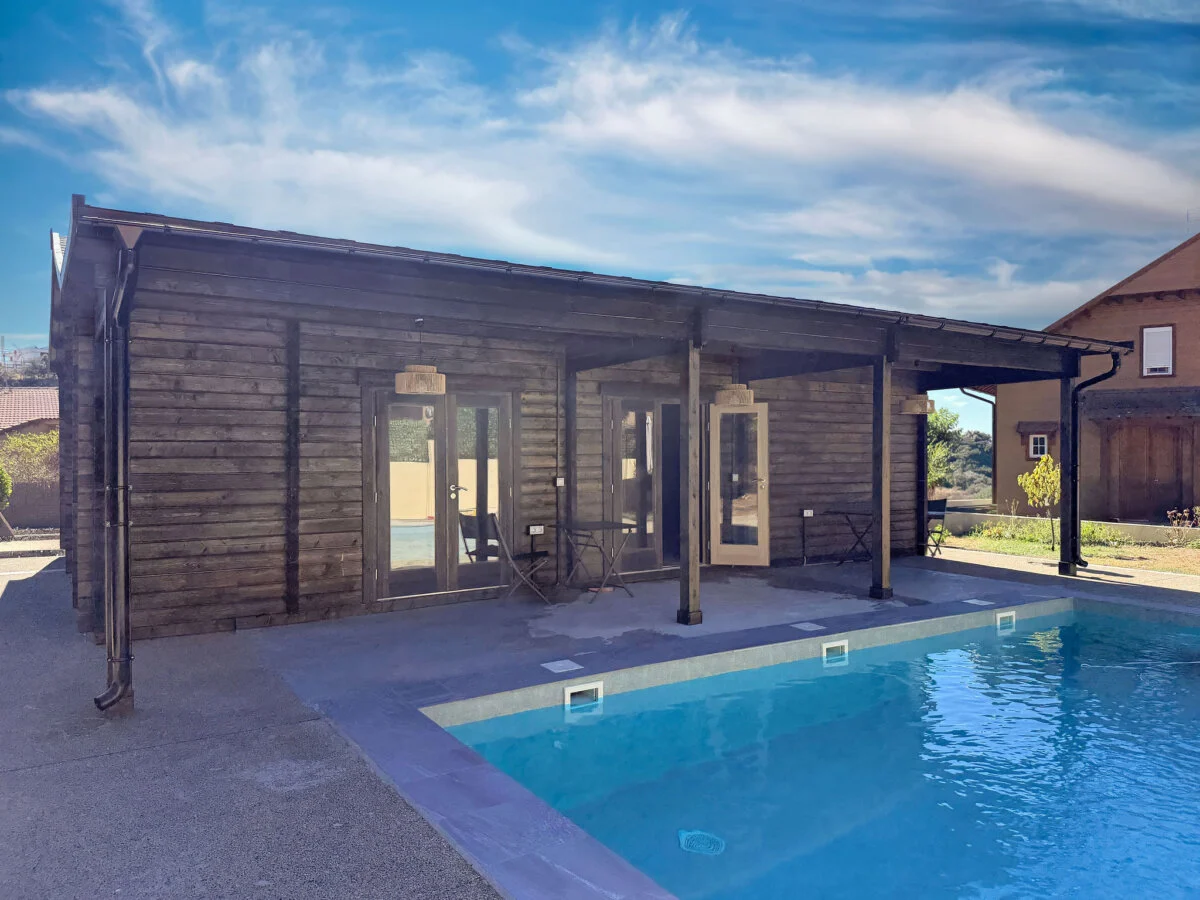
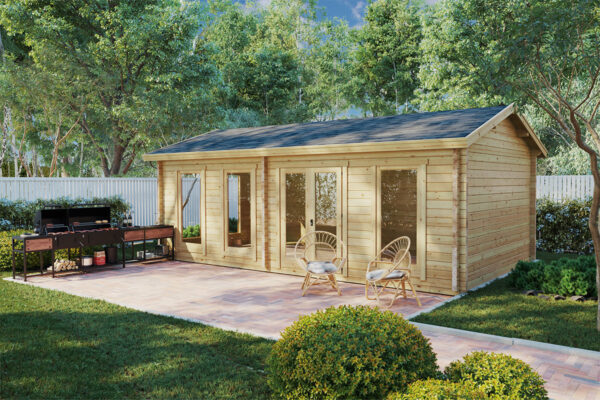
A well-maintained, pigmented exterior coating—like the one on this garden guest house—shields timber from UV degradation, repels driving rain, and discourages surface-boring insects.
If you are planning a large garden room, workshop, or home office, choosing the right structure and foundation detailing makes all the difference. As direct manufacturers, we provide expert guidance and deliver nationwide across Spain.
🏠 Explore Large Garden Buildings
Free delivery, professional assembly across Spain, and a 5-year warranty.
Timber buildings do not inherently attract pests simply because they are made of wood; infestations occur when timber remains wet and sits in contact with the ground. Keep your timber dry, elevated, and well-ventilated, carry out a quick check twice a year, and your building will remain sound for decades to come.
Native subterranean termites are found throughout mainland Spain, absent only from high mountain summits and exceptionally arid pockets. The Canary Islands also contend with an invasive subterranean species. In practical terms, however, whether your building is at risk depends entirely on moisture control and whether the timber directly touches the soil.
Examine the 1–2 mm exit holes closely. If the margins are sharp and clean and the bore dust inside is pale (the shade of fresh timber shavings), larvae are actively boring. If the holes are weathered, darkened, and free of fresh dust, the damage is almost certainly historic.
A high-grade stain is essential, but it only works when applied over dry timber on an isolated, well-drained base. Breathable stains shield timber from weather and surface rain, but they cannot stop rising damp from an unventilated or poorly elevated foundation. In areas with high termite activity, physical barriers and regular visual checks are just as important.