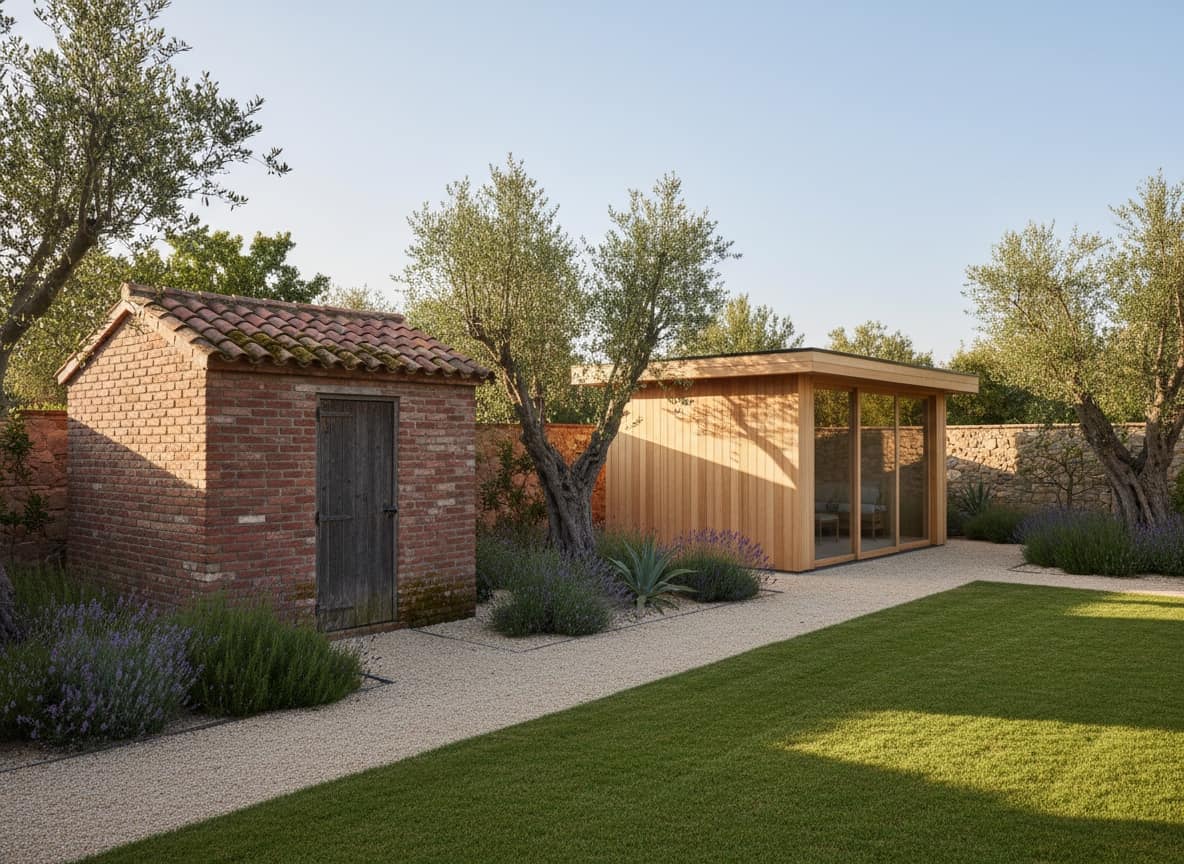
Thinking about adding a shed to your garden and torn between building one in brick or choosing one in wood? It’s one of the first decisions worth settling, because it shapes everything else: your budget, the timescales, the permits you’ll need and even what you can do with the space later on. A brick garden shed and a wooden one solve the same need, but they get there by very different routes.
In this comparison we look at both options without shortcuts: where each one wins, what they really cost, what paperwork they involve and what kind of garden and use suits each material. The aim isn’t to talk you into anything, but to put every fact on the table so you can decide.
Before we get to figures, it’s worth understanding the essential difference, because it explains almost everything else.
A brick garden shed is a building project. It involves foundations, bricklaying, a roof and drying time, usually with a team working in your garden for weeks. It’s a permanent structure built on site.
A wooden shed is a structure that has already been designed and made in a workshop. It arrives at your garden ready to install on a level base, with the joinery and the design already resolved before delivery. And far from being an off-the-shelf, “catalogue” solution, it is the starting point for beautiful spaces: our customers turn them into home offices, studios, hobby rooms and genuinely inspiring garden retreats.
That distinction – putting up a building project versus installing a shed that is already designed – is what drives the differences in cost, timing and paperwork we cover below. It isn’t that one material is “better” than the other in the abstract; it’s that they involve completely different processes.
All the quality of a solid build, without the building work
At Casetas de Jardín 24 we make every shed from premium Nordic spruce and deliver it straight from the factory, with no middleman. You get the solid, long-lasting result you are after, without weeks of building work or nasty surprises in the budget.
Factory-direct · 5-year guarantee · Thousands of customers across Europe
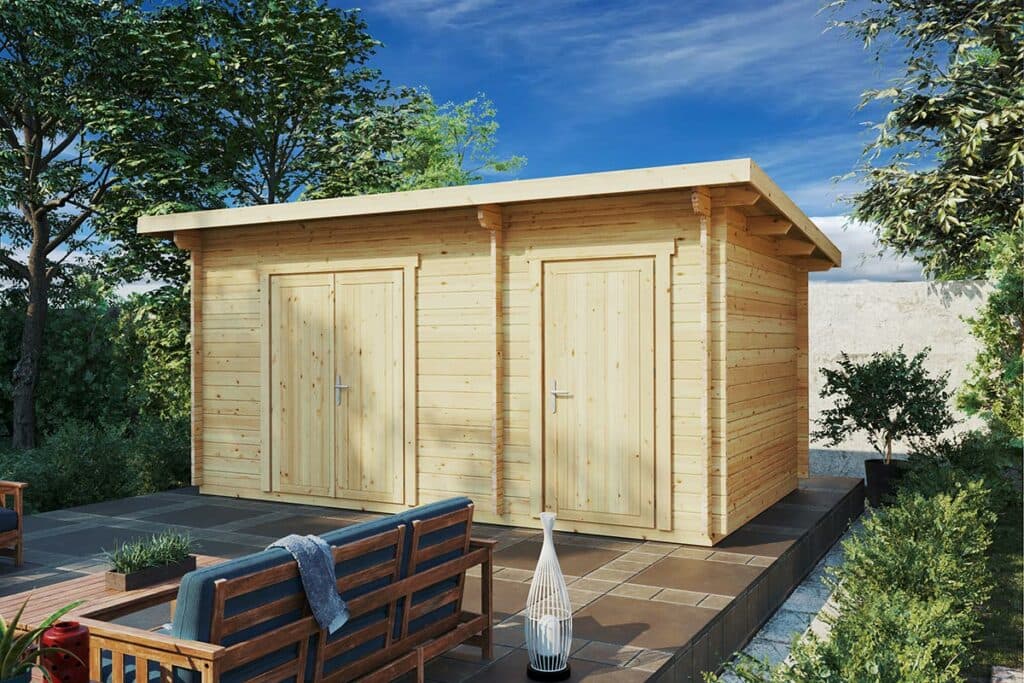
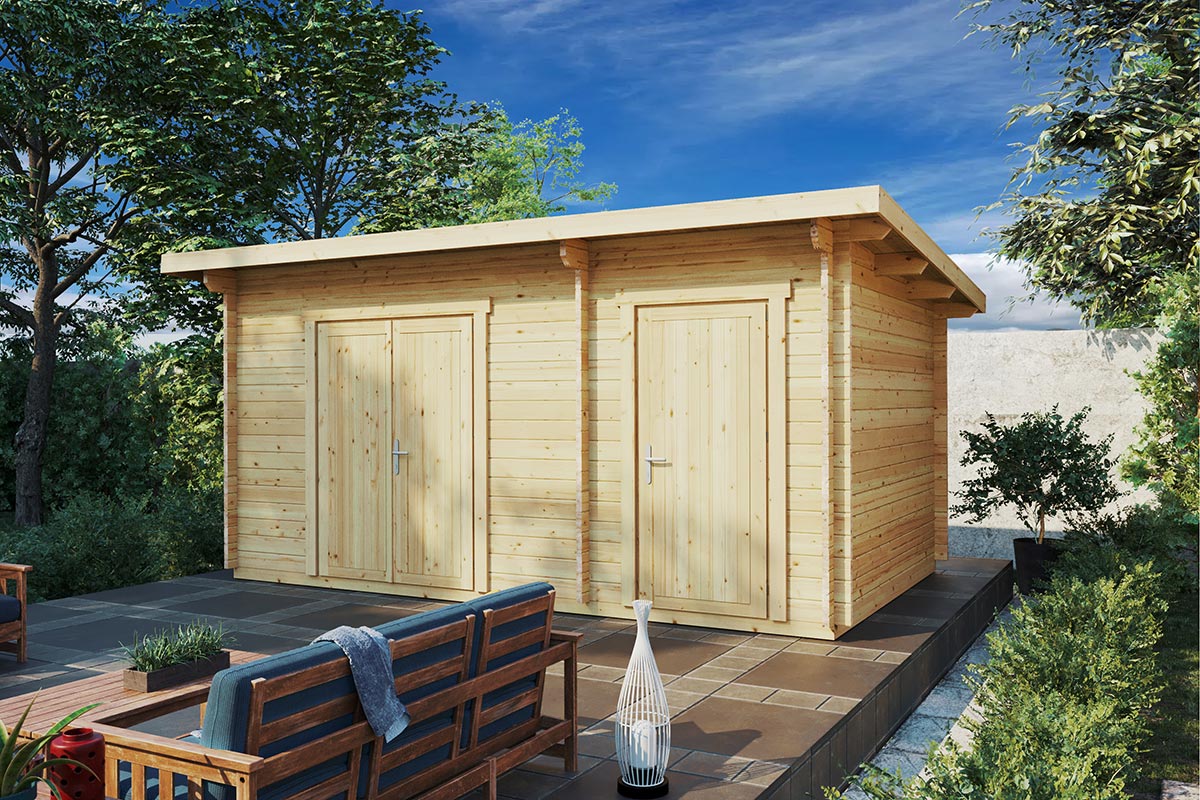
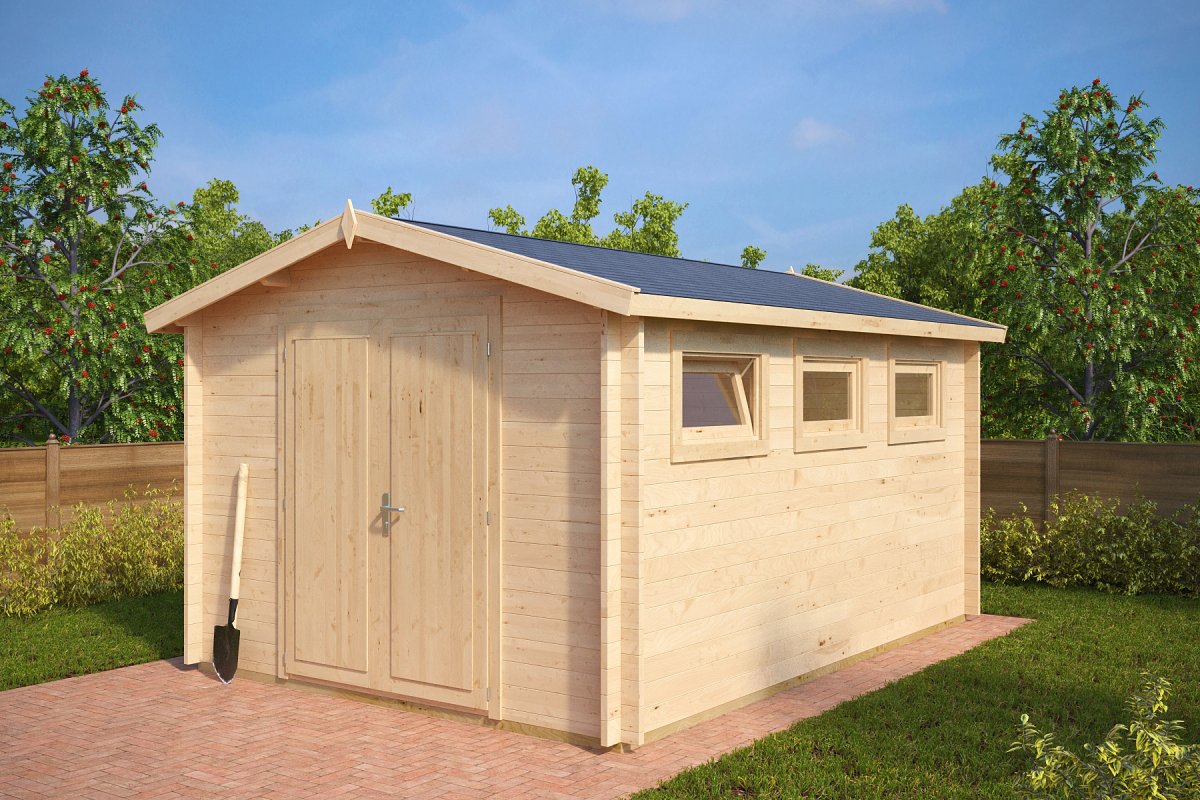
If you want the short version, this table covers the key points. We go into each one below.
| Criterion | Brick shed | Wooden shed |
|---|---|---|
| Upfront cost | High | Moderate / contained |
| Installation time | Weeks | Days |
| Foundations & building work | Required | Minimal (level base) |
| Permits | Usually treated as major works | Generally simpler* |
| Durability | Very high | High, with maintenance |
| Maintenance | Minimal | Periodic treatment |
| Insulation | Good (thermal mass) | Good (natural insulation) |
| Movable / demountable | No | Yes |
| Impact on Catastro / IBI | Possible | Lower / unlikely* |
| Bespoke result | Possible, with a project and building work | Possible, factory-direct |
*These points depend on your municipality. We explain how to check further down.
It’s the first question almost everyone asks, so let’s go straight to the answer: in most cases, a wooden shed works out considerably cheaper than building an equivalent one in brick.
The reason is fairly clear. When you build in brick, you pay for materials, foundations, labour and time. Masonry is intensive, specialised work, and the cost per square metre of a built structure reflects all of that. With a wooden shed, by contrast, much of the value is already resolved at the factory, and assembling it on a prepared base is far quicker and cheaper.
Here’s a rough guide to the prices of both options:
The Casetas de Jardín 24 range runs from under 10 m² to over 40 m². Approximate prices go from €5,000 to €6,500 for sheds of 5 to 9 m², and around €7,000 for 16 m² models. A 12 m² shed (such as the Eva D or Jacob E) costs between €5,500 and €6,400, while 24 m² models sit between €13,000 and €16,000, depending on finishes, fittings and extras. All are supplied as a kit with doors, glazed windows, floor, roof and fixings.
By comparison, according to Habitissimo¹, a brick shed costs on average around €250/m², and one in concrete blocks around €300/m². That said, these figures are for very basic specifications and can vary depending on the finishes and the complexity of the build.
The CYPE Price Generator², for its part, estimates a finished masonry shed at between €450 and €700/m², including foundations, structure and finishes. On those figures, a 10 to 15 m² shed could cost between €5,500 and €9,000, and a 20 to 25 m² one between €10,000 and €15,000.
It is important to know that construction costs keep rising: according to the ACR Direct Construction Costs Index³, in 2025 they went up by 5.5%, driven particularly by labour. What is more, reports from the Observatorio Industrial de la Construcción and BBVA Research⁴ point out that the shortage of skilled workers is lengthening timescales and pushing up the cost of building work in Spain. While a wooden shed can be ready and installed in a few weeks, a brick build can stretch to months, with the added risk that the initial budget creeps upward during the work.
It is also worth weighing up the other big question: buy or build. Building from scratch gives you total control over the design, but you have to add the project, the permits, the materials and the labour. Buying a ready-made wooden shed removes much of that budget uncertainty, because you know what you are paying from the start. If keeping the spend down is your priority, we have a guide with ideas for building a garden shed without blowing the budget.
The difference here is very visible, though it is worth qualifying. A brick build requires digging and laying the foundations, waiting for them to cure, putting up the walls, fitting the roof and letting it dry. All that work happens in your garden and, between one stage and the next, several weeks is normal, with the weather adding further delays.
With a wooden shed, the bulk of the work doesn’t happen in your garden but in the workshop, and that changes the timescales completely. If you choose a model in stock, you can have it very soon. If you would rather have a bespoke shed or one made to order, manufacturing takes a few weeks – but that is workshop time, not building work at your home. Companies like Casetas de Jardín 24 design and make their own sheds, which makes customising them much cheaper: moving the position of doors and windows, adding or shifting internal partitions, or adjusting the dimensions, for example.
The base needs to be ready before delivery. In both cases you need a firm, level surface, but wood saves you the deep foundations of a build: in many cases a well-sorted base frame is enough. This preparatory work is always completed before delivery and installation, and it is something our team can organise.
The installation itself is quick: from a couple of days to a few, depending on the size, and the smallest sheds can be put up in a single day by professionals. It is no abstract promise: we have documented projects where a large garden room goes up in four days, with the team on site and the shed finished by the end of the week.
This is one of the points where the two options differ most, and also one that causes the most uncertainty.
As a general rule, a permanent brick structure tends to fall into the category of “obra mayor” (major building works). That means that, in many municipalities, it requires a building licence (licencia de obra) and, depending on the size and characteristics, a signed technical project, plus the corresponding tax (ICIO). As it is a permanent building, it may also be reflected in the Land Registry (Catastro) and, with it, in your property tax (IBI).
A wooden shed, especially if it is demountable and has no permanent foundations, is usually subject to simpler procedures. But we need to be clear: there is no single rule for the whole of Spain. The regulations depend on the region (comunidad autónoma) and, above all, on the town hall (ayuntamiento), and even on whether the land is urban or rural. What is settled with a simple prior notification in one municipality may require a licence in another.
That is why the advice is always the same: before buying or building anything, check with your town hall what procedure applies in your case. To point you in the right direction, we have gathered the essentials on the regulations for installing a wooden house, and if your plot is rural, it is worth reading first about what you can put on rural land, because the rules change quite a bit.
Here it is only fair to acknowledge an advantage of brick: it is extremely durable and needs almost no maintenance. A well-built masonry structure lasts decades without intervention.
Wood is also very durable, but with one important caveat: it needs periodic maintenance. A quality wooden shed, treated properly and checked from time to time, lasts many years in perfect condition. What it asks in return is attention: a protective treatment renewed periodically to defend it against damp, sun and insects. It is neither complicated nor expensive, but it does have to be done. If you would like to know which products to use and how often, we have a guide on the best wood treatment for your shed.
Put another way: brick demands more of you at the start (building work, money and time) and less afterwards; wood demands less at the start and a little consistency over time.
Both options can offer good interior comfort, but they achieve it in different ways. Brick provides thermal mass: it is slow to heat up and slow to cool down, which helps to stabilise the temperature. Wood is a natural insulator in its own right and, when combined with good wall insulation, performs very well both in the cold regions of the north and in the heat of the south.
If you are going to put the shed to a use that calls for comfort – a home office, a workshop, a hobby room – insulation makes more difference than the material itself. We explain how to insulate the walls of a wooden shed to get the most out of it in any climate.
When it comes to looks, it is a matter of taste. Brick sheds convey a sense of solidity and sit especially well alongside masonry homes. Wooden ones, for their part, bring warmth and a more natural feel that fits easily into almost any garden. On top of that, both materials allow a wide variety of finishes and colours.
In terms of security, brick sheds stand out for their robustness and resistance, which tends to create a greater sense of protection. Quality wooden sheds, fitted with good ironmongery and proper locking systems, offer more than enough security for everyday garden use. That said, a masonry build still conveys greater strength and deterrent value.
There is a common misconception worth clearing up: bespoke design is not exclusive to wooden sheds. A brick shed can be designed exactly to your taste; after all, it is built from scratch. The difference is not in the scope for personalisation, but in the cost, the complexity and the timescales. When you build in brick, a bespoke solution means a project, building work and long timescales. With wood, you can get an equally bespoke result – your size, your layout, with a porch or a storage area – factory-direct and assembled in days, without going through a full build. The same goal, by a much shorter route.
A shed made to your measure, at factory prices
Customising need not cost a fortune. Because we manufacture in-house, we adapt the size, the layout and the finishes to your garden and save you thousands of euros compared with a bespoke build. We have been doing it for years for customers across Europe.
5-star Trustpilot rating · Factory-direct · Free delivery included
Wood has an advantage that goes unnoticed until you need it: it is not final. A wooden shed can be extended, modified or even taken apart and moved if you change house or reorganise your garden. A brick structure is permanent by definition: what you put up stays put, and undoing it means embarking on another building job.
That permanence is exactly what some people want, and for them brick makes complete sense. But if you value being able to change your mind later – or you would rather not commit the land to a fixed building – wood keeps the door open. Along the same lines, if you are comparing materials, you might also be interested in our comparison of resin versus wooden garden sheds.
There is no single answer, but there is a simple way to find your bearings depending on what you are after:
For most gardens and the most common uses, a wooden shed delivers practically the same result as a masonry one but with a notably smaller outlay, less time to complete and less paperwork. Either way, the best decision is the one that fits your needs. If you would like help pinning it down, this guide on how to choose your garden shed takes you through it step by step.
Which is cheaper, a brick shed or a wooden one? In most cases, a wooden shed is cheaper than building an equivalent one in brick, because it avoids the foundations, much of the labour and the timescales of a build. Brick concentrates the cost at the start.
Does a garden shed need a building licence? It depends on the municipality and the type of shed. A permanent brick structure is usually treated as major works and requires a licence. A demountable wooden shed usually involves simpler procedures, but not always. Always check with your town hall before you start.
How long does a wooden shed last? Many years if it is well maintained. The key is to apply a protective treatment and renew it periodically to protect it against damp, sun and insects.
Can a wooden shed be customised as much as a masonry one? Yes. You can choose the size, the layout and extras such as a porch or storage area, or order it fully bespoke. The difference compared with brick is that this bespoke result is achieved factory-direct and in a few days, without a full build.
How long does it take to put up a wooden shed? Usually days, compared with the weeks a brick build requires. On a level base, even large models can be finished in around a week.
Sources used: