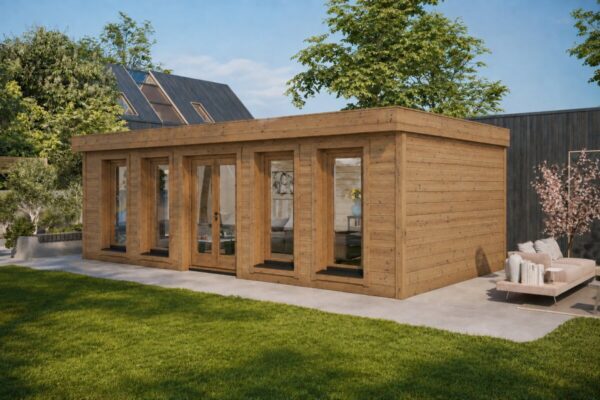
Living in a wooden house by the sea is entirely achievable, but a successful build hinges on two critical factors: exactly how far your plot sits from the shoreline—governed by Spain’s strict Coastal Act (Ley de Costas)—and how well you protect the timber from chronic moisture and salt air.
Before breaking ground, keep these four fundamentals in mind:
Whether you can build depends strictly on which coastal planning zone your plot occupies. Spain’s Coastal Act (Ley 22/1988, de Costas) establishes three distinct coastal strips. Crucially, these are measured inland from the inner limit of the seashore—defined by the highest reach of historical storms—rather than the high-tide line on a calm day.
| Zone | Width | Legal Implications |
|---|---|---|
| Maritime-terrestrial public domain (Dominio público marítimo-terrestre) | Seashore, beaches, and designated coastal dunes | State-owned public land. Any private occupation requires an administrative permit or formal state concession. |
| Transit easement (Servidumbre de tránsito) | 6 m, extendable to 20 m across difficult or hazardous terrain | Must remain entirely clear for public access, coastal surveillance, and rescue vehicles. Any proposed works require direct approval from the State Coastal Authority. |
| Protection easement (Servidumbre de protección) | 100 m, extendable up to 200 m | Buildings intended for residential or habitable use are strictly prohibited. Permitted secondary or auxiliary uses require formal regional administrative authorisation. |
A common misconception is that timber structures bypass these rules. The law regulates the intended use (habitation and residence), not the construction method. Solid log profiles, prefabricated wall panels, and demountable or “mobile” timber chalets are all subject to the exact same legal restrictions. If your land sits within 100 metres of the sea, do not sign a purchase contract or order a building until both the regional coastal authority (Servicio de Costas) and your local town hall (ayuntamiento) confirm in writing that your project is permitted.
How to navigate your build:
Your next step is choosing a building engineered to withstand coastal weather. We manufacture Nordic spruce houses with wall profiles up to 88 mm thick.
Direct manufacturer with over 20 years of experience and a 5-year guarantee.
Contrary to popular belief, salt air is not timber’s primary threat. Field research on marine timber structures reveals that wood handles salt exposure remarkably well—far better, in fact, than concrete or unprotected steel. What destroys coastal timber is relentless cycling between wetting and drying, paired with the rot-causing organisms that thrive in damp conditions.
Moisture control is the deciding factor. Wood-decay fungi activate as soon as internal moisture levels exceed 20%, according to guidelines from the International ThermoWood Association. This makes vulnerable building details—where rainwater pools, splashes back, or enters via capillary action—the real danger zones: ground-contact points, exposed end grain, window sills, and shallow roof overhangs.
Nordic spruce (Picea abies) has a natural heartwood durability rating of Class 4 (slightly durable) against fungal attack, with its sapwood rated Class 5 (not durable) under UNE-EN 350. Unfinished, it will not survive long-term weather exposure. An exterior timber wall elevated off the ground falls under Use Class 3 of the EN 335 standard: exposed to outdoor weather and rain, and vulnerable to both fungal decay and wood-boring insects.
Ultraviolet radiation compounds the problem by degrading surface lignin and turning exposed wood grey. In coastal microclimates, high solar reflection off the water accelerates this process, making pigmented finishes and regular re-coating schedules essential.
A coastal wooden building must sit on a sub-base that isolates it from ground moisture and lets prevailing breezes sweep beneath the structure. Our wooden house foundation guide breaks down foundation engineering in detail, but near the ocean, several non-negotiable rules apply:
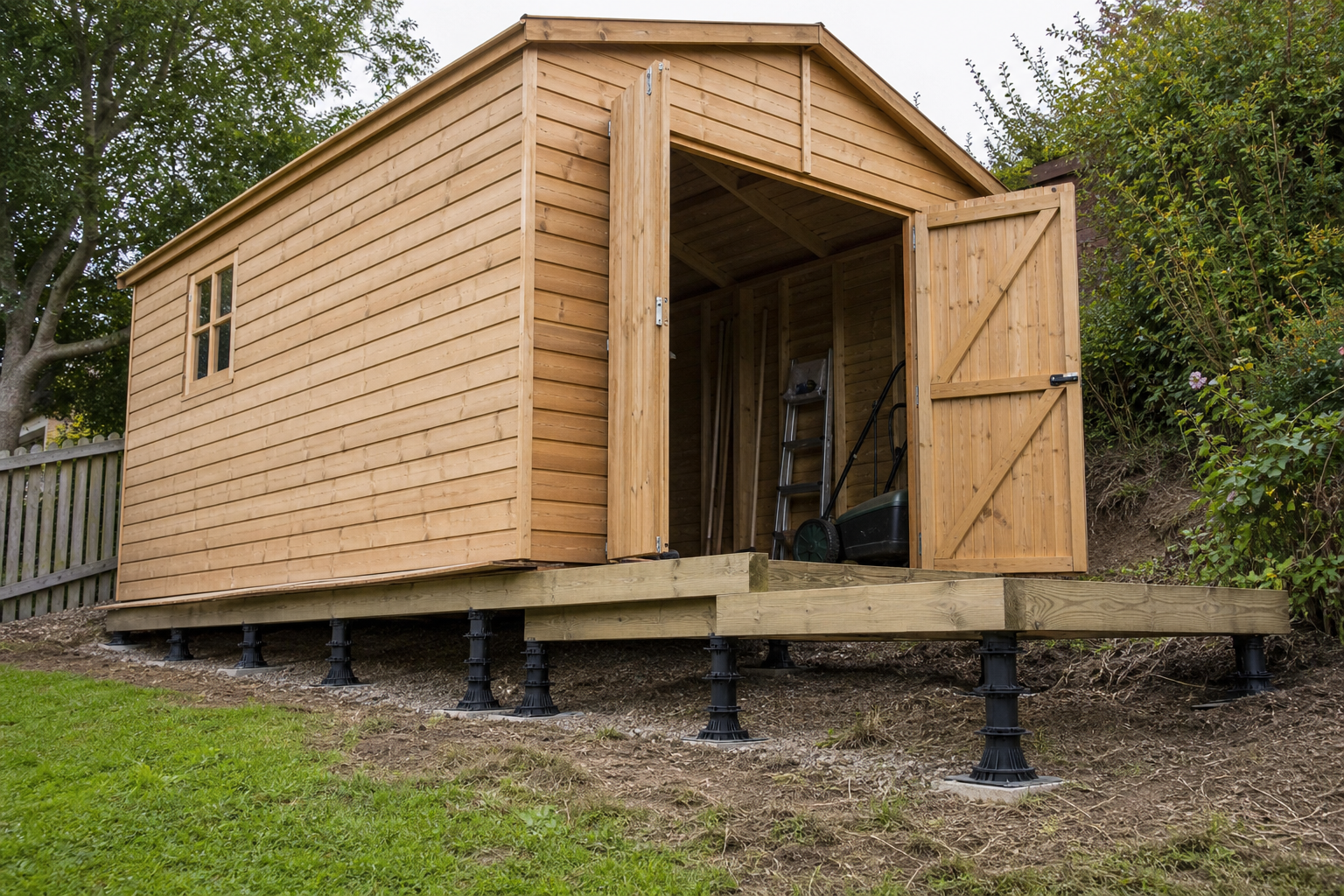
Adjustable riser pedestals are an ideal choice, especially on sloped sites, because they make levelling straightforward while keeping the subfloor ventilated. If you pour a conventional concrete slab, you must install an under-slab moisture barrier and mount the cabin on pressure-treated structural battens to allow air to pass beneath the floorboards.
When it comes to termites, mainland Spain hosts two widespread native subterranean species: Reticulitermes grassei and R. banyulensis. Coastal plots face no greater termite risk than inland areas, but preventing wet timber and blocking soil contact is vital to stop them nesting. Under Spain’s CTE DB SE-M building standard, structural timbers must be safeguarded according to their Use Class, with deep preservative treatments required in regions with recorded termite activity.
Selecting your wall thickness: If you intend to use the cabin year-round, choose a 70 mm solid timber profile. A 44 mm wall is ideal for a seasonal hobby studio or garden office, but 70 mm delivers the structural rigidity and thermal mass necessary to buffer coastal wind loads and damp winters.
High ambient humidity mixed with airborne sea spray quickly corrodes metal connectors, structural brackets, and assembly screws. In coastal construction, fasteners must be checked annually and specified correctly from day one:
The ISO 9223 standard rates atmospheric corrosivity from C1 to C5, with C4 denoting high corrosivity and C5 very high. While topography and prevailing winds alter these lines, technical galvanising standards generally treat areas within 1 km of the sea as C4, and sites within a few hundred metres—or facing direct sea winds—as C5. In these conditions, specify A4 stainless steel without exception.
Be careful to avoid galvanic corrosion during assembly: pairing stainless steel fasteners directly with galvanised brackets in damp conditions causes the zinc to sacrifice itself rapidly. Always match identical metals throughout every connection, or isolate them using EPDM gaskets or non-conductive nylon washers.
For Nordic spruce, the gold standard is a pigmented, microporous (breathable) wood stain, applied in two thorough coats inside and out within four weeks of assembly. Microporous stains penetrate deeply, let trapped water vapour escape freely, and can be freshened up later without aggressive sanding. Applying an exterior finish within this initial month is also required to maintain our 5-year structural warranty, which excludes timber damage caused by moisture ingress or neglected finishes. For step-by-step guidance, explore our garden building wood treatment guide.
How often you need to recoat depends on your chosen product: plan for every 1–2 years with entry-level finishes, 3–5 years with mid-grade coatings, and 6–7 years with premium architectural stains. Over a 15-year period, that amounts to 8 to 15 maintenance sessions with budget products, 3 to 5 with mid-range options, and just 2 to 3 using premium finishes. On the coast, intense UV and salt-laden winds push recoating schedules toward the shorter end of these estimates, especially on south- and west-facing elevations.
A sensible coastal maintenance checklist:
For more detailed upkeep routines, see our comprehensive log cabin and wooden house maintenance guide.
Thermally modified timber (TMT) is processed under extreme heat to alter its cellular structure and break down hemicelluloses—the primary food source for decay fungi and the component responsible for water absorption. The International ThermoWood Association notes that Thermo-D treated spruce and pine achieve Class 2 durability under EN 350, meet Use Class 3.2 requirements, and display remarkable dimensional stability, swelling and shrinking up to 50% less than untreated timber. Note that it remains unsuitable for direct ground contact.
Thermally modified cladding is an exceptional choice if you want to minimise maintenance on weather-beaten, windward walls. While it still requires an elevated base and airflow underneath, it largely frees you from ongoing painting cycles. Our insulated garden rooms feature thermally modified exterior timber as standard.
Thermally modified cladding handles coastal moisture with ease and keeps its shape year after year. Explore our insulated garden rooms designed for year-round living.
Includes professional assembly, delivery, and exterior factory painting, backed by a 5-year guarantee.
The bottom line: verify your plot’s position relative to the coastal boundary before spending money, raise the building to promote constant subfloor ventilation, use marine-grade A4 stainless steel, and stay ahead of your finish maintenance before bare wood is exposed.
In almost all cases, no—not for residential use. Spain’s coastal protection easement (servidumbre de protección) covers the first 100 metres inland from the shoreline boundary and strictly outlaws residential and habitable buildings of any type. Before buying a structure, consult your regional coastal authority (Servicio de Costas) and municipal planning department to determine what can legally be installed on your land.
No. Salt does not decay wood; biological rot requires sustained moisture levels above 20%. A raised base, ample subfloor airflow, and a breathable exterior stain will keep the timber sound. Salt does, however, aggressively corrode metal fixings, which is why marine-grade A4 stainless steel is essential in coastal zones.
Maintenance frequency depends on coating quality: budget stains need refreshing every 1–2 years, mid-range finishes every 3–5 years, and premium microporous coatings every 6–7 years. Inspect weather-facing walls every spring and after major coastal storms, touching up any weathered spots promptly.