If your cabin door is sticking, scraping against the frame, refusing to latch, or letting in drafts, you can usually solve the problem in just a few minutes with an Allen key. Most of our log cabins and garden rooms are fitted with adjustable 3D hinges, which let you fine-tune the door leaf in three directions:
Because we fit several door styles across our range, adjustment points can vary slightly. If your hinges look different from the ones described below, check your building’s assembly manual for model-specific instructions.
Wood is a hygroscopic material that continually absorbs and releases moisture as ambient humidity levels change. When timber takes on moisture, it expands; as it dries out, it shrinks. Outdoors—even when fully sheltered from direct rain—timber in Southern Europe typically fluctuates between 7% and 20% equilibrium moisture content, according to regional agricultural data.
During damp summers or extended rainy periods, door leaves take on moisture and swell, often causing them to catch or drag against the frame. In contrast, dry weather causes the wood to contract, widening the gaps around the edges.
Natural building settlement is another major factor. A timber building settles considerably over its first twelve months, which is why doors often need a few rounds of adjustments during their first year. Window and door frames are deliberately engineered to sit within slightly oversized wall openings so the surrounding timber can move without binding. For this reason, log cabin manufacturers generally recommend a thorough check and alignment tune-up around the one-year mark.
A well-built, properly treated garden building saves you countless headaches down the road. Our cabins are crafted from premium Nordic spruce, feature double-glazed windows as standard, and come backed by a 5-year warranty.
🏠 Explore garden rooms & cabins
Direct manufacturer with over 20 years of experience and a 5-star Trustpilot rating.
Before reaching for your tools, gently close the door and take a close look at where it binds or why the latch is missing the strike plate. Pinpointing the issue first ensures you make the right adjustment.
| Symptom | Adjustment needed |
|---|---|
| Door scrapes the frame on the hinge side | Lateral: shift the leaf toward the latch side |
| Door scrapes the frame on the latch/handle side | Lateral: shift the leaf toward the hinge side |
| Door rubs at the top or drags along the threshold, or the latch sits too high/low | Height (bottom hex socket) |
| Drafts entering or weatherstripping fails to create a tight seal | Depth/compression (top hex socket) |
To get started, you will need an Allen key (standard 3D hinges usually take a 4 mm key), a timber wedge or an extra pair of hands, and a small spirit level.
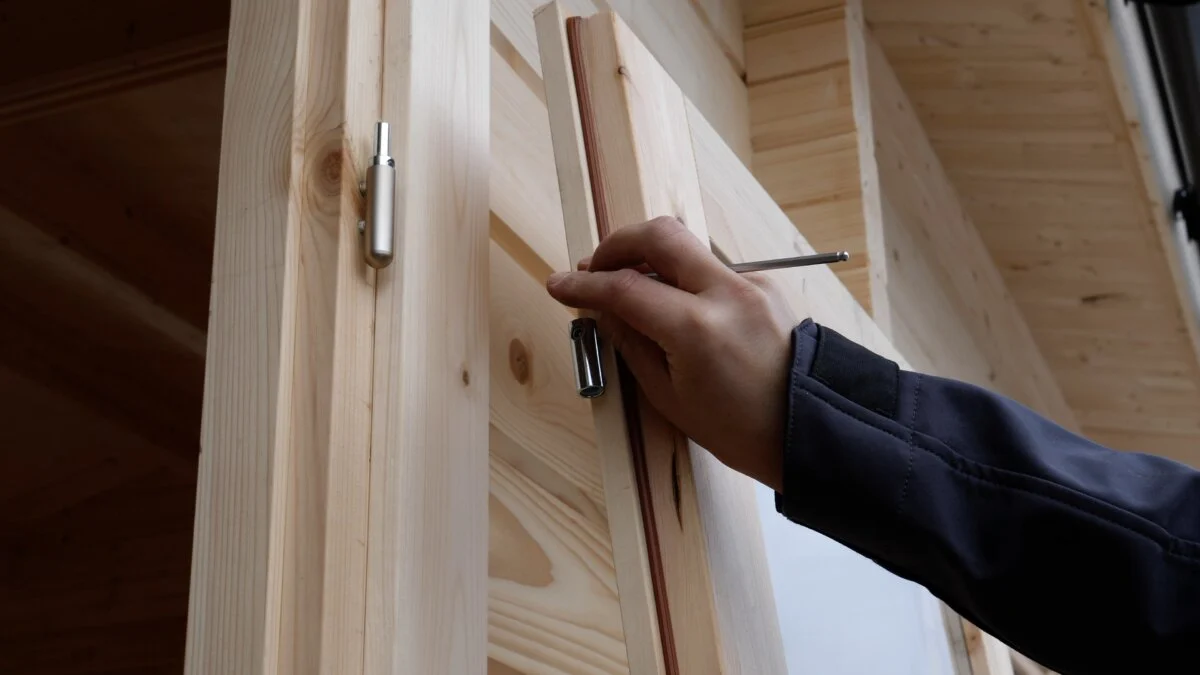
Standard 3D hinges are precision-engineered with defined tolerances—most models offer roughly ±3 mm of lateral movement and ±1.75 mm of depth adjustment. Always make adjustments gradually and evenly across all hinges, and never force a mechanism past its stop point. If your doors use hinges secured with clamping screws rather than internal hex drives, back each screw off by about a third of a turn, support the leaf with shims, realign it, and re-tighten the screws firmly without stripping the threads.
To put this seasonal movement into perspective, take a door leaf built with 120 mm wide stiles. In winter, the timber might sit at 12% moisture content, rising to 18% during a humid summer. According to a standard industry rule of thumb from Finnish wood coatings specialist Teknos, wood changes roughly 1% in dimension for every 3% shift in moisture content. A 6% swing in moisture therefore causes roughly a 2% dimensional change—expanding each stile by approximately 2.4 mm.
Across two vertical stiles, that adds up to nearly 5 mm of total width expansion. While exact figures depend on timber species and grain orientation, this simple calculation shows why doors can start binding during wet or humid periods. A quick lateral adjustment of 2 to 3 mm readily restores the necessary clearance. Come winter, when the wood dries and contracts, you may simply need to wind that adjustment back.
If a door suddenly drops out of square, or if you have maxed out the hinge adjustments without fixing the problem, the door itself might not be the culprit. An uneven foundation can throw the entire structure off-level, causing doors and windows to stick. Check that the base remains level and review our guide on log cabin foundations. If the door leaf is warped or split, or if the internal lock mechanism is damaged, contact technical support before forcing any moving parts.
A stable foundation and quality slow-grown timber make all the difference. We offer direct delivery across Spain and professional on-site installation by our own expert team.
🏠 View log cabins & garden buildings
Factory-direct manufacturing: no middlemen and a comprehensive 5-year warranty.
Exterior doors must be treated inside and out with a premium wood preservative or breathable, microporous finish to block moisture ingress and guard against weathering. Proper surface protection is the best way to keep your joinery working smoothly year-round.
Pay particular attention to the top and bottom end-grain edges, as well as cutouts around locks and handles, which are especially vulnerable to moisture absorption. The European standard EN 927-2 highlights that end-grain timber draws in moisture far faster than face grain and requires thorough sealing on all exterior joinery. If you had to plane or sand an edge during adjustment, apply several coats of sealant before rehanging the door. For detailed advice on treatments and maintenance intervals, see our guides on choosing the best finishes for timber cabins and general log cabin maintenance.
In short: diagnose where the door is binding, make small, balanced adjustments across all hinges, and check clearances seasonally during your cabin’s first year. Keep the timber well-sealed, and your doors will deliver years of smooth, trouble-free operation.
During the first year, check your doors at every seasonal change as the building settles and humidity fluctuates. After this initial settling period, you will generally only need minor tweaks if you notice sticking or drafts.
Yes. All you need is an Allen key and a little patience. That said, having an extra pair of hands to support the door leaf when lifting it off and back onto the hinges makes the process much safer and easier, especially with heavy or double-glazed doors.
Timber absorbs moisture from humid summer air, causing the stiles and rails to swell. A quick lateral hinge adjustment of just one or two millimeters is usually all it takes to restore smooth operation.