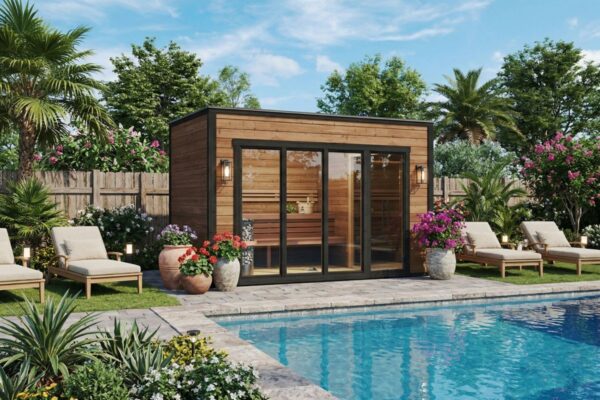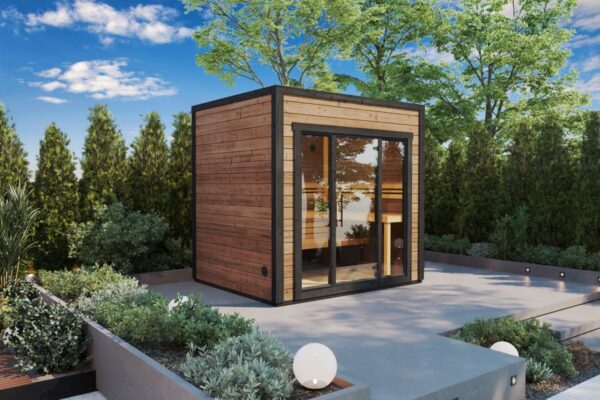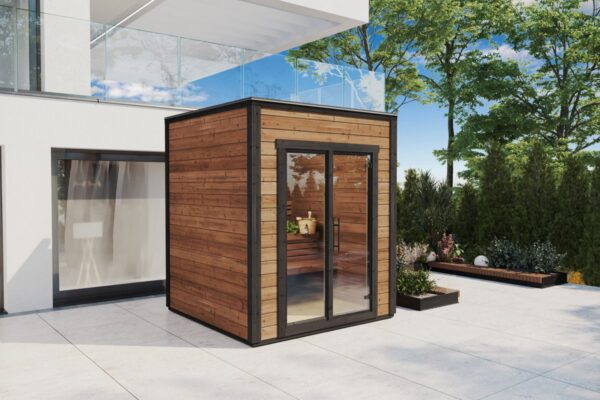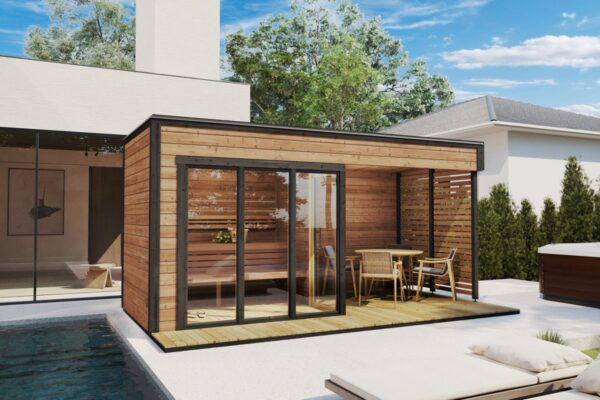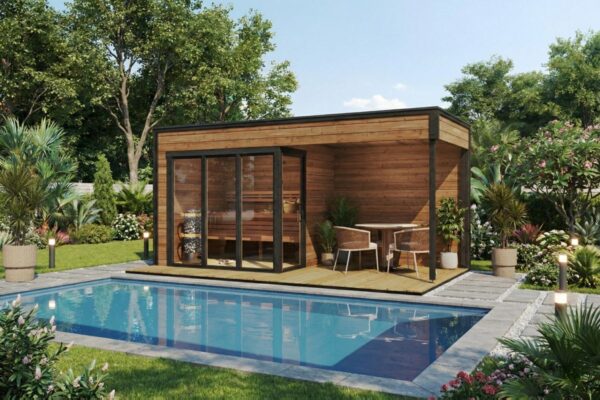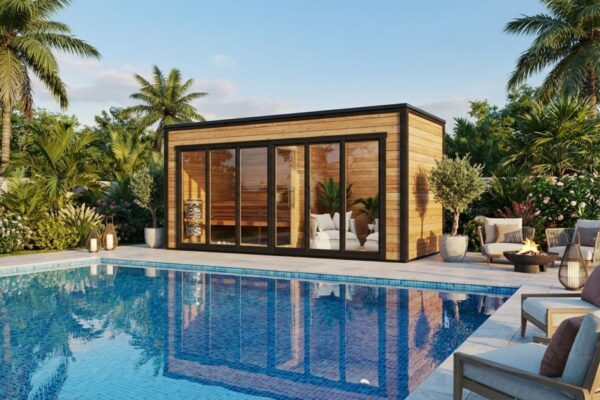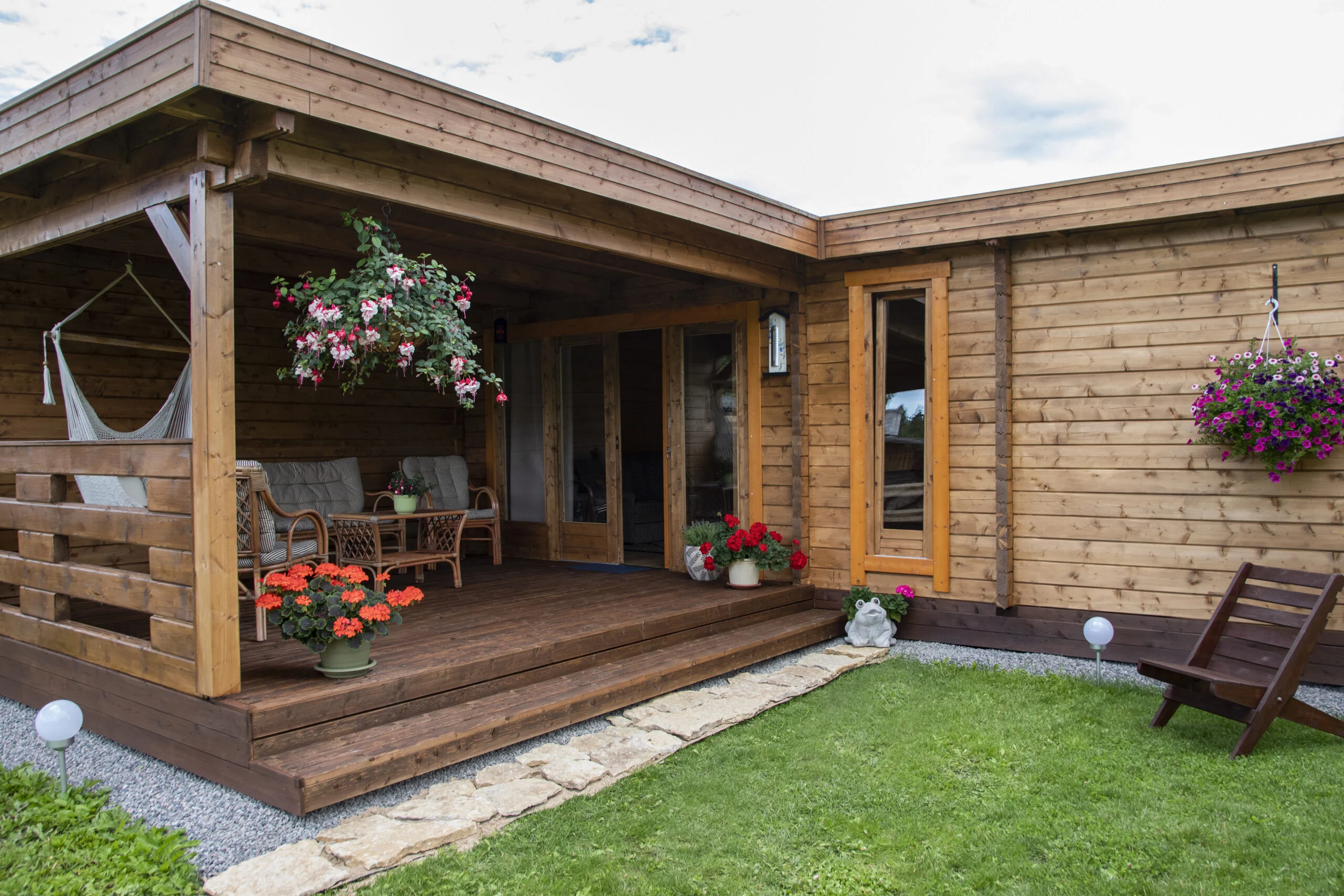
Even in southern Spain, the chilly evenings between October and May make a garden sauna just as rewarding as it is in Finland. The further north you live, the more months of the year you will enjoy it.
To ensure your build goes smoothly from start to finish, tackle your project in this order:
There is no single rule for all of Spain: requirements depend on regional planning regulations and your local town hall (ayuntamiento). For instance, the regional government of Andalusia (Junta de Andalucía) stipulates that building and installation works generally require a municipal planning permit (licencia urbanística), unless they qualify for a prior notification or responsible declaration (declaración responsable / comunicación previa). Many local councils allow smaller outbuildings under this fast-track procedure; however, factors such as total floor area, permanent concrete foundations, or habitable use may trigger the need for a full building permit.
Building on pier blocks, concrete footings, or ground screws often simplifies approval because the structure is not deemed a permanent building. Nevertheless, always check with your local planning department to confirm which procedure applies and what minimum setback distances you must respect from property boundaries. If your property is on rural land (suelo rústico), planning restrictions are much tighter—we cover this in detail in our guides on wooden cabins on rural land and planning regulations for installing a log cabin.
Casetas de Jardín 24 designs and manufactures saunas crafted to authentic Nordic standards at our own factory in Estonia. We offer free, no-obligation advice to help you choose the ideal size and model.
Nordic craftsmanship · Certified quality · Free expert advice
Your foundation determines whether the doors close properly and how long the timber lasts. Outdoor sauna manufacturers require an entirely level, load-bearing base—such as a reinforced concrete slab or strip footings—with a bituminous damp-proof membrane installed between the concrete and the wooden base frame. Strip foundations must extend at least 80 cm deep only in inland regions prone to severe frost. Ground screws provide an excellent lightweight alternative, lifting the cabin off the ground to ensure continuous airflow underneath.
The most common mistake is setting an outdoor sauna directly onto grass or soft soil. Timber absorbs moisture, the frame settles unevenly, and doors quickly begin to stick. Level your base down to the millimetre and slope the surrounding ground away from the structure so rainwater cannot pool near the wood.
A standard family sauna room typically measures between 1.5 x 2 m and 2 x 2 m, accommodating 3 to 5 people at a time. It is best to have at least one wall measuring around 2 metres so you can comfortably lie down on the upper bench.
There is no reason to build larger than necessary: a bigger hot room requires a more powerful heater, driving up your electricity bill.
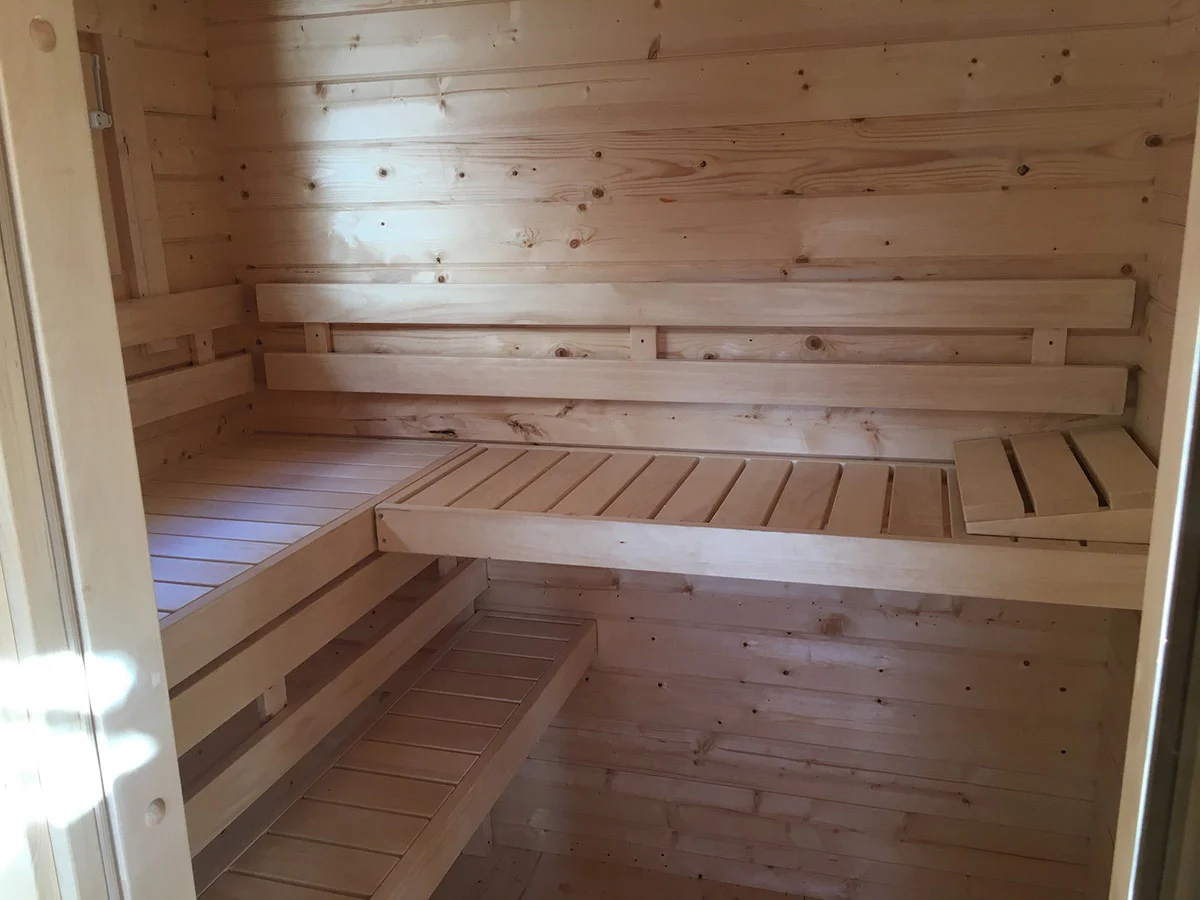
Beyond the hot room itself, an outdoor sauna cabin can incorporate a shower, changing room, relaxation lounge, covered porch, or even guest accommodation and an outdoor kitchen. If you also need a garden office or home entertainment room, combining these into a multifunctional cabin saves both garden space and construction costs.
A traditional sauna house complete with a sauna room, shower, changing area, and lounge generally spans between 10 and 15 m². Alternatively, you can opt for a compact 1.5 x 2 m or 2 x 2 m sauna and simply use the bathroom inside your home.
The primary consideration is heating output in kilowatts, calculated from the volume of your sauna room: height x width x depth. Harvia recommends an average baseline of 1 kW per cubic metre. Uninsulated surfaces such as glass or stone require additional power: Harvia recommends adding 1.2 m³ of calculated volume per square metre of uninsulated surface, while HUUM factors in 1 m³.
For example, a 2 x 2 m sauna with a ceiling height of 2.3 m has an internal volume of 2 x 2 x 2.3 = 9.2 m³. If the cabin features a full-glass door measuring approximately 1.3 m², add 1.3 x 1.2 = 1.6 m³, bringing the effective volume to 10.8 m³. Looking at the Harvia Cilindro heaters available with our Fjord line, the PC70XE (6.8 kW) is rated for 6–10 m³, while the PC90XE (9 kW) covers 8–14 m³. For 10.8 m³, the PC90XE is the right choice.
The PC70 can run on either a single-phase 230 V or three-phase 400 V supply, but the PC90 and PC110 models require a three-phase 400 V connection. If your home has a single-phase electrical supply, consult your electrician before making a final selection.
Electric heaters hold between 19 and 80 kg of sauna stones; a larger rock capacity produces softer, longer-lasting steam (löyly). For outdoor installations, we recommend floor-standing tower heaters with 50 to 80 kg of stones.
Heaters can be operated via built-in dials, digital wall-mounted controllers, or smartphone apps that let you preheat the sauna remotely—saving you from waiting around during the standard 45–50 minute heat-up period. Sauna heaters generally cost between €450 and €1,500, with dependable, entry-level Finnish models starting under €500.
All electrical wiring must be installed by a certified electrical contractor. In Spain, the Low Voltage Electrotechnical Regulations (REBT) govern these installations under ITC-BT-50 (locations with sauna heaters), while your installer will also consult ITC-BT-30 regarding damp and wet locations. Always observe the safety clearances to combustible surfaces specified in the manufacturer’s manual.
With an electric heater, the air inside the sauna should be exchanged approximately six times per hour, according to Harvia and HUUM guidelines. The exact positioning of intake and exhaust vents depends on whether you rely on natural or mechanical ventilation, so always follow your heater’s installation guide.
Building a sauna entirely from scratch requires custom-framing an insulated ceiling, building ergonomic benches, installing heater guards, and fitting specialised sauna doors. Our prefabricated kits include all these components out of the box, allowing an experienced DIYer to assemble a 2 x 2 m cabin in just two to three days.
We highly recommend our latest Fjord line, crafted from 40 mm thermally modified timber (ThermoWood). Treated using only heat and steam without any chemicals, this wood offers superior resistance to moisture, rot, and dimensional movement. Over time, untreated ThermoWood weathers naturally to a refined silvery-grey patina; if you prefer to maintain its deep, warm tone, simply apply a pigmented wood stain after assembly.
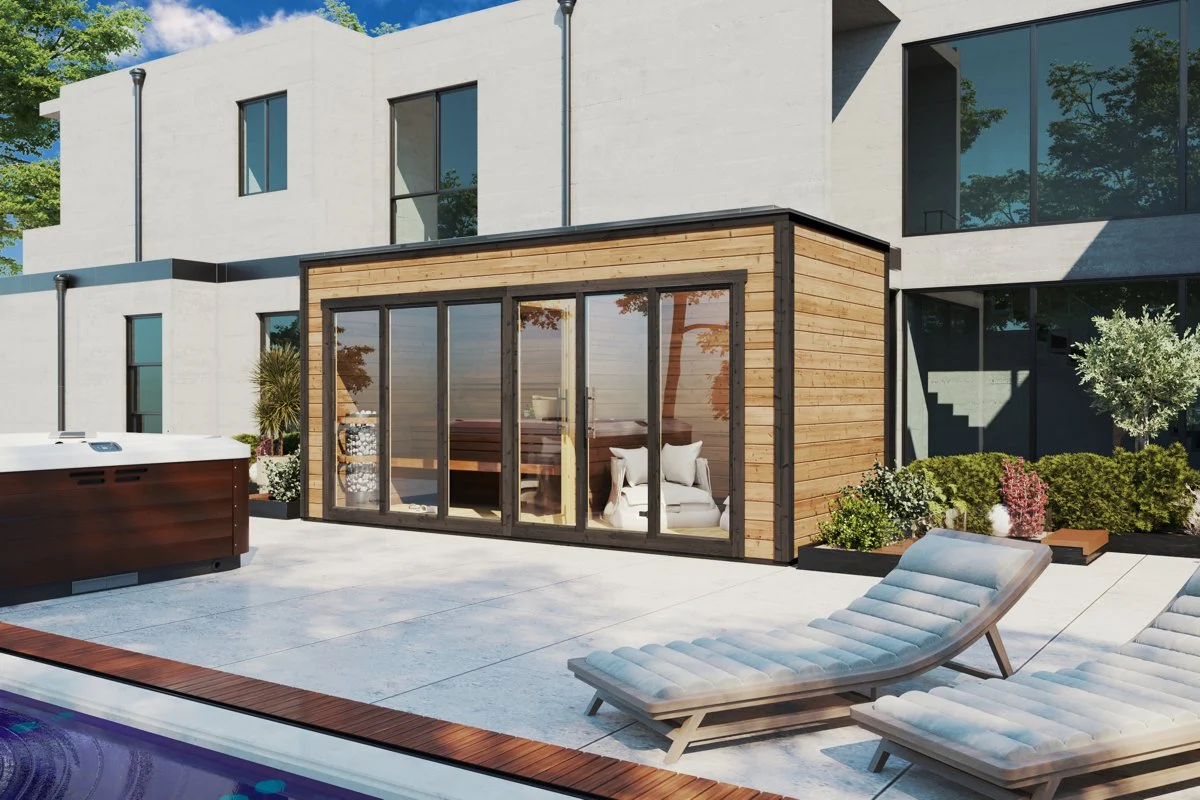
One detail to consider: 40 mm wall thickness is slimmer than the 70 mm solid logs used in our classic outdoor saunas, which heat up faster and retain heat longer in harsh winter conditions. If you live in a colder inland area, compare both options across our full range of outdoor saunas.
Prefabricated sauna kits start between €5,000 and €6,000 and can exceed €20,000 depending on dimensions, layout, and timber specifications. In addition to the kit price, you should budget for the base, assembly, and the heater. A compact 2 x 2 m sauna—fully assembled, with an electric heater and basic ground prep—typically runs between €7,500 and €9,000. A traditional sauna cabin with a shower and changing room ranges from €15,000 to €20,000.
Based on current pricing as of October 2026, standalone Fjord kits (excluding heaters) are priced at €5,950 (Lyse), €7,060 (Sogne), €8,170 (Aurland), €9,540 (Nord), €9,640 (Geira), and €10,540 (Lyngen). For the Nord and Lyngen models, Harvia Cilindro heater packages can be added from €1,100 (PC70XE) up to €1,950 (PC110XE). For a comprehensive breakdown, read our guide on how much an outdoor home sauna costs.
We offer outdoor saunas ranging from compact 2 x 2 m models to comprehensive 30 m² garden lodges with showers, changing rooms, lounges, and verandas. Request your free, no-obligation quote today.
Free delivery, 5-year warranty, and over 20 years of manufacturing experience.
With planning verified, a solid level base prepared, and the correct heater selected, all that remains is stepping inside to enjoy your first session. When you are ready, check out our guide on how to use a traditional Finnish sauna.
It depends on your local council. Many Spanish municipalities permit small garden outbuildings under an expedited prior notification or responsible declaration (declaración responsable), but total square footage or permanent foundations can trigger a standard building permit. Always verify with your local planning department before ordering.
Typically 45 to 50 minutes. Choosing a heater with mobile app controls allows you to start the heating cycle before you even arrive home.
As a baseline, allow 1 kW per cubic metre, plus an allowance for uninsulated glass surfaces. For an effective volume of 9 to 10 m³, a 6.8 kW Harvia Cilindro PC70XE works well; if your cabin features large glass walls or doors, step up to a higher-capacity model.