If you have at least a metre of clear driveway space and want to keep costs down, a classic up-and-over door is hard to beat. If you regularly park right outside the garage, plan to use the interior as a workshop, or need every millimetre of drive-through clearance, a sectional door is well worth the extra spend. That is the quick rule of thumb.
Before gathering quotes, you will want to weigh up four crucial factors: driveway clearance, internal headroom, insulation requirements, and the true cost of adding an electric operator.
| Feature | Up-and-Over Door | Sectional Door |
|---|---|---|
| Exterior driveway clearance | ~1 m required for panel swing | Zero clearance required |
| Lintel headroom | Minimal: 50–65 mm (Hörmann Berry models) | 100–115 mm above opening; 90 mm side reveal (Hörmann, up to 4 m wide) |
| Thermal insulation | Moderate | High (insulated sandwich panels up to 42 mm thick) |
| Typical installed price (3 × 2.5 m) | €2,100 (galvanised steel) | €1,400 (aluminium sandwich panel) |
| Electric motor (supply & fit) | €400–750 | €450–900 |
Price estimates sourced from Habitissimo and HelpDone. Note that these baseline figures reflect different panel materials and should not be compared like-for-like at face value (see our cost breakdown below).
An up-and-over door consists of a single rigid panel that kicks outward as it opens. As it swings upward, the bottom edge arcs out into the driveway before tucking flat beneath the ceiling. Leroy Merlin advises leaving roughly one metre of clear space directly in front of the opening. If you park a second car bumper-to-door, or if your driveway slopes steeply straight from the threshold, you will have to shunt vehicles around every time you want to open up.
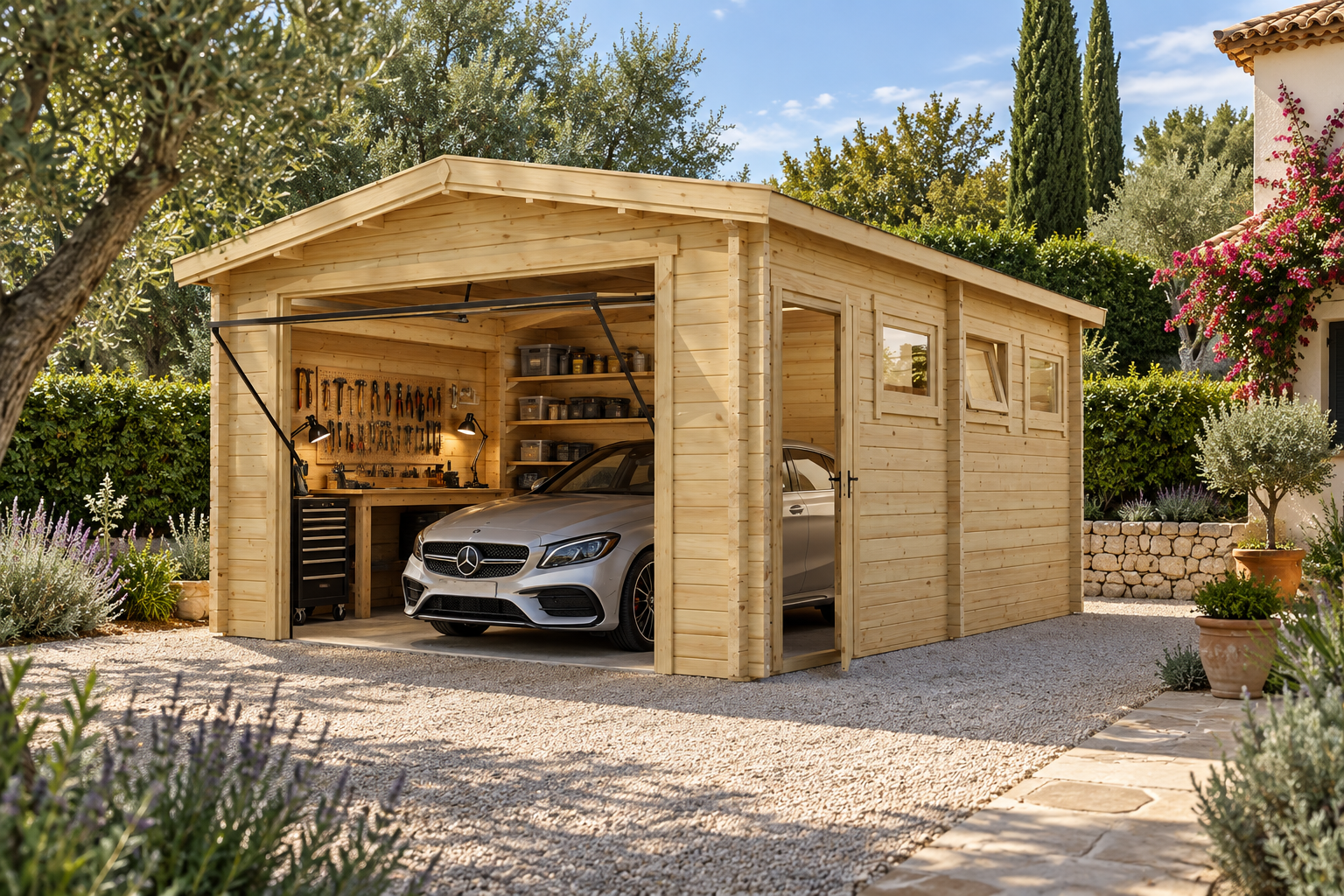
A sectional door operates on a purely vertical track. Hinged horizontal sections roll straight up along guide tracks and glide back along the ceiling, never breaking the plane of the exterior wall. According to Hörmann, this vertical travel provides up to 14 cm more usable drive-through width than an equivalent up-and-over door—a substantial difference when guiding a wide SUV through a standard 3-metre opening.
However, trading away exterior swing means demanding more space inside. For a door 2.125 m high fitted with an electric motor, Hörmann specifies at least 115 mm of lintel headroom, meaning your finished ceiling height must be at least 2.24 m. Furthermore, the horizontal ceiling tracks reach deep into the garage: Novoferm calculates required ceiling depth as the door height plus 620 mm. That is easy enough to accommodate in a standard 5.5-metre-deep bay, but it can easily foul overhead storage racks, loft hatches, or pendant lights in more compact structures.
For openings exceeding 4 metres wide, sectional doors also rely on heavier torsion spring assemblies that need even more clearance above the frame. For a standard single-car garage, however, this rarely presents a problem.
Before choosing a door, make sure your building dimensions fit your vehicle. Our timber garages leave roughly 1 metre of clearance on either side of a car and are delivered as complete kits.
Direct from the manufacturer: over 20 years of experience, free delivery, and a 5-year guarantee.
Leroy Merlin rates sectional doors as having high thermal efficiency, compared to moderate performance for standard up-and-over designs. This gap comes down to panel construction and edge sealing:
Which design suits your setup?
Bear in mind that a well-insulated door will do little good if your walls and roof lack insulation. If you intend to heat the space, explore our guide on how to insulate a timber garage.
Industry trade averages from Habitissimo quote around €1,400 to supply and fit an aluminium sandwich-panel sectional door (3 × 2.5 m), compared to €2,100 for a galvanised steel up-and-over door of identical dimensions. At first glance, that makes sectional doors look cheaper—yet this comparison pits lightweight domestic aluminium against heavy-gauge galvanised steel. Looking at standard building cost databases (CYPE), a 3 × 2.5 m manual sandwich-panel sectional door sits around €1,425, jumping to roughly €2,566 once automated (excluding VAT).
Automation shifts the final figures considerably:
To get an accurate comparison: Always request itemised quotes based on the exact same clear opening dimensions, equivalent panel materials, and matching finishes—with electric operators priced separately. Comparing unmatched specifications will only muddy your budget.
Burglary protection. While sectional doors are often marketed as inherently more burglar-resistant, independent testing reveals that neither mechanism offers an automatic advantage. Physical security depends primarily on cylinder quality, multi-point locking latches, and the rigidity of the frame installation, rather than whether the door folds or tilts.
Safety regulations. Every garage door sold in the European Union must comply with harmonised standard EN 13241, which governs mechanical safety and operating tolerances. Under the EU Construction Products Regulation (No. 305/2011), suppliers must provide a Declaration of Performance (DoP) and carry a visible CE mark. Motorised systems must also feature anti-crush, pinch-point, and obstacle-detection failsafes. Always ask to see the CE plate and the Declaration of Performance, and steer clear of uncertified products.
Ongoing upkeep. Sectional doors feature a higher count of moving parts—tension springs, lifting cables, hinges, and track rollers—all operating under significant mechanical load. Hörmann’s Series 40 technical guidance specifies an annual inspection by a qualified technician, while Novoferm recommends inspections every six months. Never attempt to adjust, repair, or loosen tensioned counterbalance springs yourself. Routine servicing costs vary with local labour rates, so factor ongoing servicing intervals into your long-term ownership plan rather than letting them dictate your purchase.
Note: These criteria assume a plumb, square opening. Corbelled brickwork, dropped joists, or surface-mounted pipework can foul sectional ceiling tracks and should always be inspected by a professional installer beforehand.
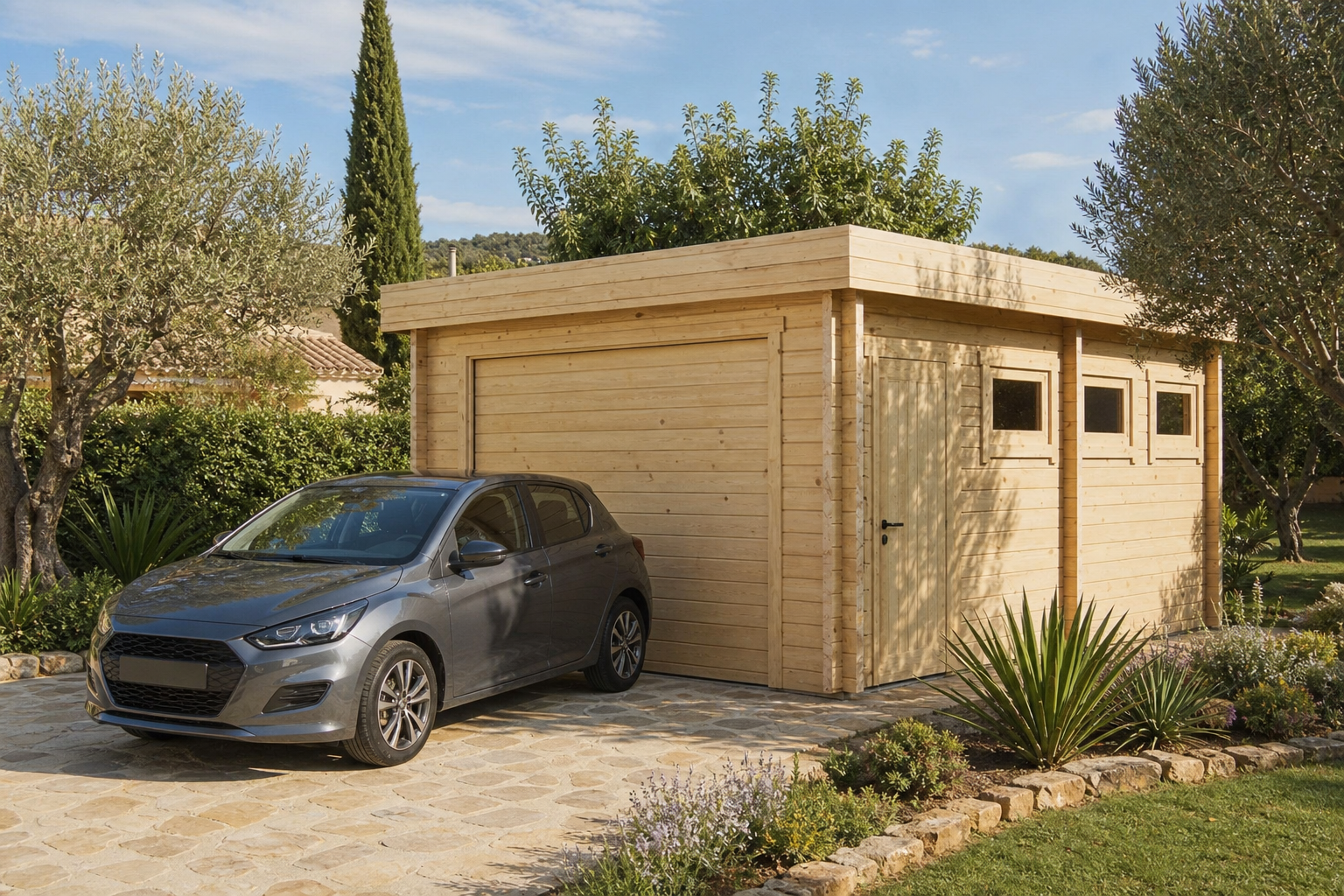
Our Deluxe range of 70 mm log-cabin garages comes fitted with German-engineered Hörmann up-and-over doors measuring 2.96 × 2.04 m (the Deluxe G model features a 2.90 × 1.99 m opening). Our 44 mm wall models feature side-hinged double wooden doors with a clear opening of 2.37 × 1.96 m. For detailed floor layouts and vehicle clearances, consult our guide to single-car garage dimensions.
Keep these practical points in mind before ordering:
The verdict: An up-and-over door is a proven, mechanical, cost-effective choice as long as your driveway can spare the swing arc. A sectional door is the superior design when outside space is tight, thermal performance is paramount, or you need maximum drive-through width. For standard residential timber garages, the included Hörmann up-and-over door strikes the ideal balance of durability, security, and everyday dependability.
Save the hassle of sourcing and coordinating doors separately. Our Deluxe timber garages include premium Hörmann up-and-over doors as standard. Delivered as a complete flat-pack kit with professional installation available.
Direct from the manufacturer: factory pricing, 5-year guarantee, and free delivery.
It depends on where your spatial constraints lie. Sectional doors open straight up, meaning they require zero clearance on your driveway. However, they need 100–115 mm of lintel headroom and 90 mm of side reveal inside. Up-and-over doors sweep out by roughly one metre in front of the garage as they open, but require far less interior lintel height (only 50–65 mm on Hörmann Berry models).
Generally yes, once compared like-for-like. While an aluminium sandwich-panel sectional door may carry an entry-level quote of roughly €1,400 compared to €2,100 for heavy galvanised steel up-and-over gear, the material grades differ. When automated, sectional setups tend to run higher overall: benchmark construction pricing places an automated 3 × 2.5 m sectional door at roughly €2,566 before VAT. Always compare quotes specifying matching finishes and operators.
Yes. Most modern up-and-over doors can easily be fitted with an electric operator, usually costing between €400 and €750 including installation. While our timber garage kits arrive with manual Hörmann up-and-over doors, an aftermarket ceiling-mounted motor can be installed at any time by a qualified technician.