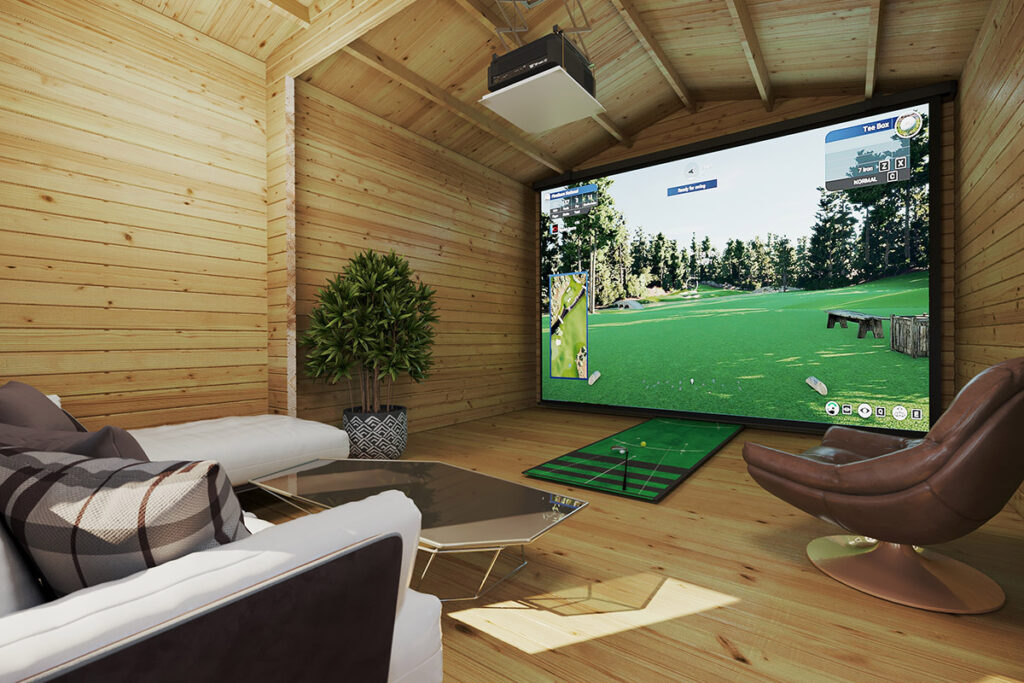
Before you compare simulators, projectors or screens, there’s one question that decides the whole project: where are you going to put it? Most guides treat space as an afterthought. Here we treat it as what it actually is: the factor that determines whether your simulator works properly or falls short.
Every measurement in this guide is in metres, with honest ranges depending on the type of equipment, and a realistic look at where these dimensions actually exist in a Spanish home (and where they don’t).
A golf simulator needs a minimum of around 2.85 m of height, 3.5 m of width and 5 m of depth, although the recommended dimensions for comfortable play are 3 m or more of height, 4.5 m of width and 6 m of depth. The exact range depends on the type of launch monitor.
| Dimension | Minimum | Recommended |
| Height | 2.85 m | 3.0 – 3.2 m |
| Width | 3.5 m | 4.5 – 5 m |
| Depth | 5 m | 6 m or more |
Be careful with the minimums: these are figures at which the system works, not figures at which you play comfortably. The manufacturers themselves acknowledge that when a golfer is even slightly aware of the ceiling, the swing changes. Let’s go through it measurement by measurement.
Because the driver is unforgiving. A modern driver measures around 1.15 m, and at the top of the swing arc the clubhead can reach above 2.7 m. If your ceiling is lower than that, you have two options: shorten your swing (and distort every data point) or give up the driver altogether. And a simulator without a driver is half a simulator.
The manufacturers’ reference figures:
As a practical reference: standard residential ceilings in Spain sit at around 2.5 m. A driver simply doesn’t fit under that.
Depth isn’t a single figure. It’s a chain of distances that add up, and this is where the type of launch monitor changes the answer.
The full chain consists of:
The equipment makes the difference in that first section. Radar-based launch monitors such as the Garmin R10 need to sit between 1.8 and 2.4 m behind the ball to track its flight, while photometric (camera-based) systems sit beside the ball and don’t eat into your depth at all. The ceiling-mounted Trackman iO doesn’t need any space behind the player either, and puts no hardware on the floor.
In practice: a camera system can work from a total depth of around 4 – 5 m, while a classic radar unit needs 6 m or more to perform well. If you’re weighing up the two technologies, our comparison of the best golf simulators covers radar versus camera in detail.
Golf simulator screens usually come in 4:3 or 16:9 format, with widths of between 3 and 4 m in home installations. Add at least 30 cm on each side between screen and wall: the screen moves with every impact.
The projector adds its own geometry. Short-throw models hang from the ceiling at 1.5 – 2.5 m from the screen, depending on the throw ratio. Two practical consequences: it takes away 20 – 25 cm of usable height around the projector area if your ceiling is tight, and it should always sit ahead of or above the player so their shadow doesn’t block the image. For a sharp picture, manufacturers recommend projectors of over 5,000 lumens.
This is where the numbers meet reality. Let’s go through the usual candidates:
| Space | Typical height | Does it work? |
| Garage | 2.2 – 2.5 m | Almost always fails on height |
| Living room | 2.5 – 2.7 m | Fails on height, and on family diplomacy |
| Basement / attic | Variable | Slopes, damp, irregular heights |
| Spare room | 2.5 m | Rarely reaches 6 m of depth |
The garage is everyone’s first candidate, and the first to fall: with a 2.2 – 2.5 m ceiling there’s no full driver swing. To be fair: if you have a high garage of over 3 m, go ahead. They exist, but they’re the exception.
The living room usually has the floor space, but neither the height nor the goodwill: few families are happy with a 3 m impact screen presiding over the lounge.
The basement or attic brings its own problems: sloping ceilings that steal exactly the height your swing arc needs, and damp that punishes the equipment.
The spare room almost never adds up to the 6 m of depth a radar system asks for.
The conclusion is uncomfortable but useful: in most Spanish homes, golf simulator dimensions don’t exist inside the house. They exist in the garden.
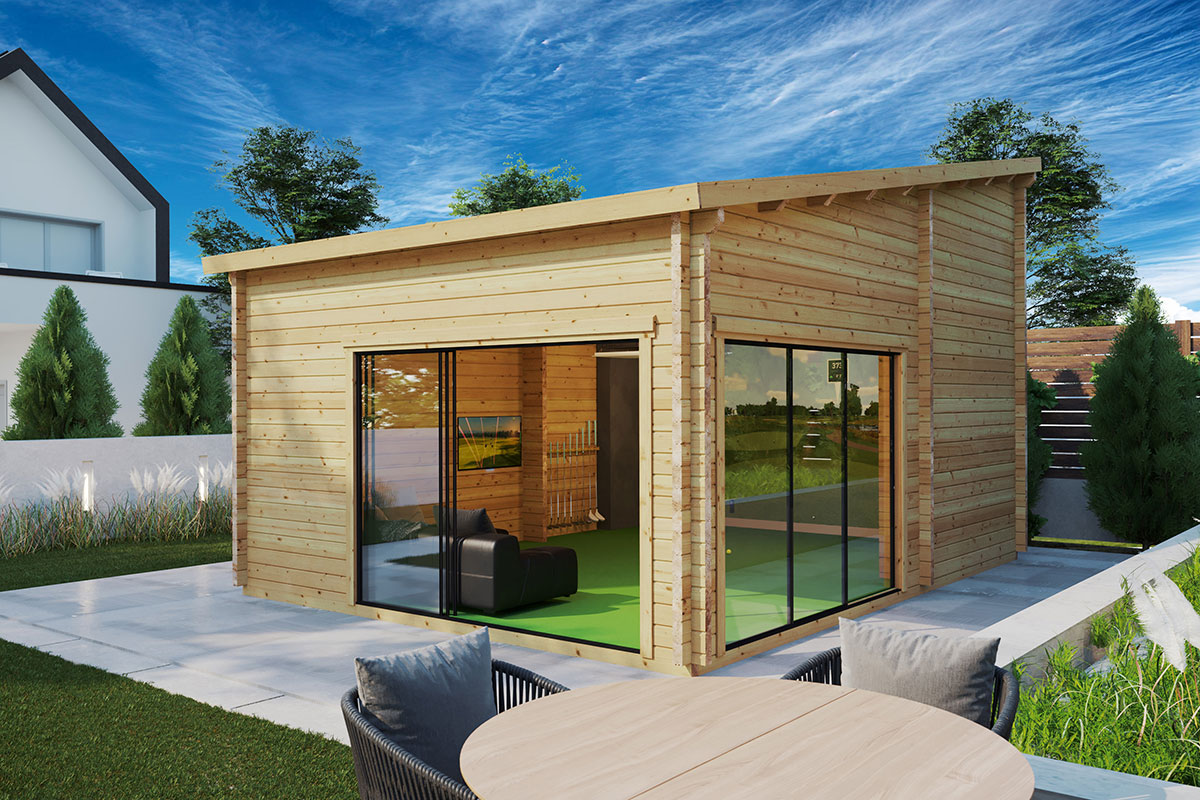
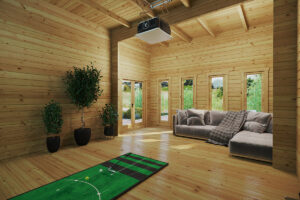
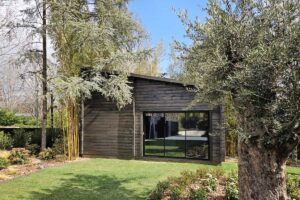
If it doesn’t fit indoors, the clean solution is to build the space around the simulator rather than the other way round. Companies like Casetas de Jardín 24 manufacture garden rooms designed specifically for golf simulators, with all the dimensions we’ve covered already solved as standard.
The Golf range shares a base of 6 × 4 m with 27 m² of interior space, 3.3 – 3.5 m of usable height and a total height of 405 cm, 70 mm walls with metal reinforcement rods and double-glazed aluminium sliding doors. Several design finishes are available: the Golf 5 cabin, the Golf 4 cabin and the Golf 3 cabin, and the height of any model can be increased on request.
The fact that these dimensions work isn’t theory. It’s built and running:

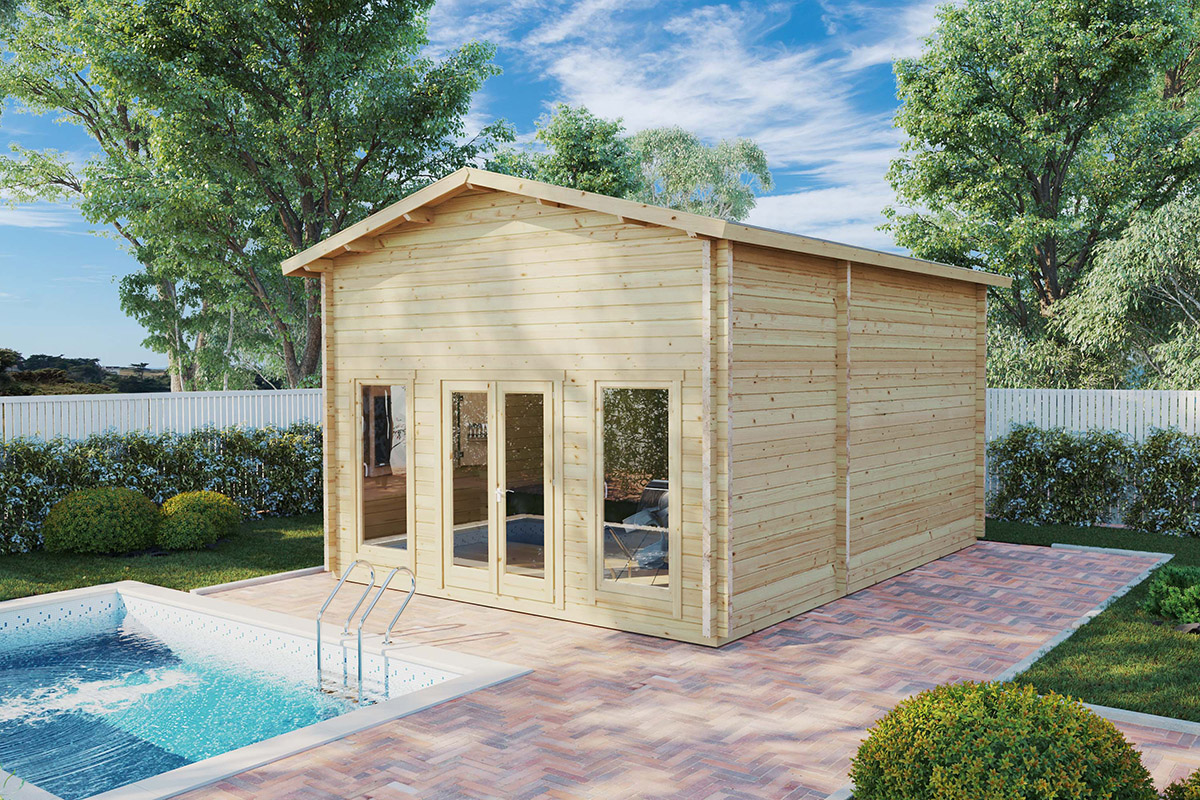
One important note: before installing any structure in your garden, check your local planning regulations.
Setting up your simulator outdoors, with a net, a mat and the launch monitor, is technically possible, and it’s actually a decent testing ground. But as a permanent installation it has three enemies: the weather (rain and sun punish both screen and electronics), projector visibility (in full daylight the image disappears) and equipment security, since you’ll hardly want to leave it out in the open.
That’s why serious setups end up under a roof. And in a garden, “under a roof” means an insulated garden room, not a marquee: thermal insulation is what makes it possible to play in August in Seville or in January in Madrid. With an insulation kit and climate control, the room works 365 days a year.
If you’re starting to plan the full project, our guide to home golf simulators covers the what and the why, and the golf simulator pricing guide covers the how much.
Every garden, every simulator set-up and every budget is different. Tell us about your situation and we’ll help you find the right solution – no obligation.
Contact us on WhatsApp or call us at 951 87 66 99 and we’ll talk you through it.
The absolute minimum is around 2.85 m, but the practical minimum for a full driver swing is 3 m, and 3.1 m or more is recommended. Standard residential ceilings in Spain (2.5 m) are not enough.
As a minimum, 2.85 m of height, 3.5 m of width and 5 m of depth. For comfortable play: 3 m of height, 4.5 m of width and 6 m of depth. Camera-based systems need less depth than radar-based ones.
Usually not. Spanish garages tend to have ceilings of 2.2 to 2.5 m, which is not enough for a driver swing. It only works if the garage is over 3 m high, which is rare.
A minimum of 2.5 m between the tee and the screen, with 3 m recommended for safety and comfort. Add another 30 – 40 cm between the screen and the wall so it can absorb the impacts.