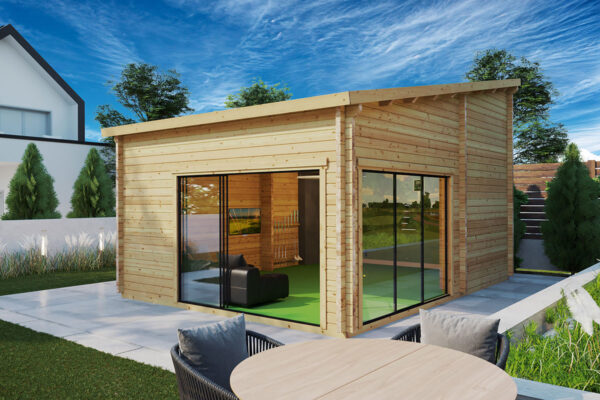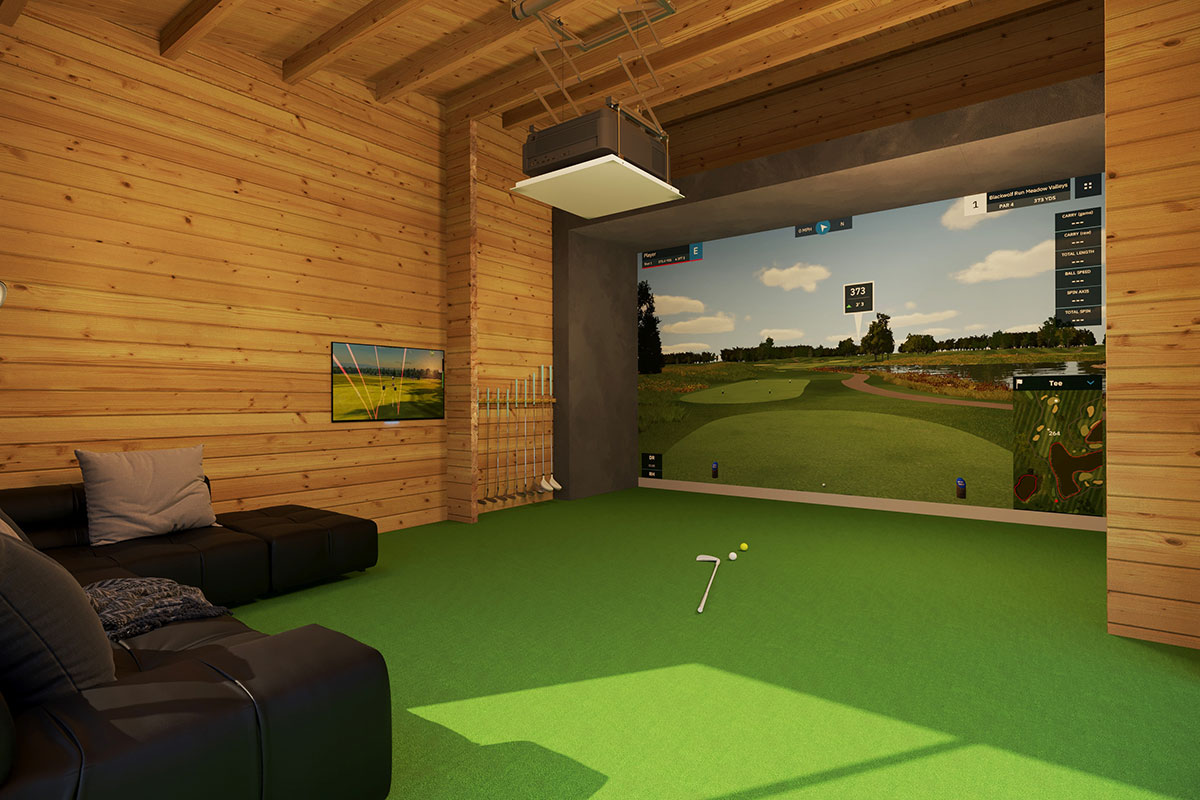
Imagine being able to play golf as if you were on a professional course, without leaving home. More and more golf enthusiasts across Spain are installing a home golf simulator that lets them train, sharpen their technique, or simply play a round on a virtual course whenever they like.
But before taking the plunge, there are a few key questions to answer: how much does it really cost?
What equipment do you need? And how much space does it take up?
In this guide, you’ll find everything you need to know about setting up a golf practice room: the cost, what it’s made up of, the space required, and the options available for creating a dedicated space without giving up a room in your house.
We’ll also walk you through several real projects completed in Spain, showing how a garden cabin built specifically for this purpose offers a practical, comfortable and long-lasting alternative.
To install a golf room at home, the first requirement is enough space to swing freely. The room needs sufficient height, width and depth for the player’s movement, and to position the impact screen and projection system correctly.
If there’s no suitable room inside the house – such as a spacious garage or basement – a garden house is an ideal alternative for creating an independent space.
Experts like Casetas de Jardín 24 offer golf simulator cabins designed specifically for this kind of set-up, making the most of the available space.
A golf simulator typically consists of a launch monitor that analyses the shot, an impact screen, a projector or display system, simulation software with virtual courses, a hitting mat, and protective elements to ensure safety during play. The choice of components depends on the level of realism and precision each user is looking for.
While some basic systems can be set up as a DIY project, more advanced simulators call for careful space planning, equipment calibration and professional installation.
The budget depends on whether you already have a suitable space (such as a garage or spare room) or need to build a new one.
Equipment only (if you already have the space):
Complete project with a garden cabin:
If you need to create an independent space, you’ll need to add the cost of the cabin to the cost of the simulator. Timber cabins built for this purpose typically cost around €14,000–25,000, since they require a larger footprint, insulation and interior height. They’re designed to allow a free swing and full training sessions.
Altogether, a complete project including a garden cabin and simulator usually requires an investment of roughly €17,000 up to more than €40,000, especially when choosing a premium simulator and a high-end installation with quality finishes, insulation, climate control and additional equipment.
While choosing the right simulator matters, one of the main challenges is finding the space to install it. You might have a garage, basement or spare room, and converting it can seem like the obvious solution. But this comes with drawbacks too: you lose usable living space, ceilings are often too low, and building work is frequently needed to meet the required dimensions.
All of this complicates matters considerably, which is why many enthusiasts opt to create an independent space in the garden instead. A cabin designed specifically as an indoor golf training room provides the height and size needed without giving up any other part of the house. And because it’s a structure built for this exact purpose, the installation can be planned around both the simulation equipment and comfort during play.
One of the best ways to understand what’s possible with a golf training cabin is to look at real, existing projects. Across Spain, different customers have created bespoke spaces to practise and enjoy golf. Here are a few examples:
In Seville, a custom garden cabin was designed as a golf training room, creating an independent, fully equipped space to enjoy the game comfortably all year round. This project shows how an outdoor structure can be built alongside a private home without taking space from the rooms inside.
Another example is the golf simulator cabin built in La Moraleja, Madrid, a project designed to make the most of the garden as a private space for training and leisure.
Casetas de Jardín 24’s solutions can also be adapted for professional installations. One example is the garden cabin for a golf simulator built at a golf club in Bilbao, where the structure was used as a practice space within a sports facility. This project shows that these builds work equally well in private gardens and professional clubs.
Once you’ve worked out the space needed for your golf simulator, the next step is choosing the right cabin. Dimensions, insulation and interior height are key factors for comfortable use during practice. Casetas de Jardín 24 offers models designed specifically for this kind of installation, with generous 6×4 m (24 m²) spaces and 70 mm thick walls – ideal for creating an independent golf room in the garden.
Three models stand out among the options available:
Garden Golf Simulator Room 5 – 27 m², 6×4 m (70 mm): a spacious option for anyone wanting a dedicated golf room at home, with enough space for a screen, projector and practice area.
Garden Golf Simulator Cabin 4 – 27 m², 6×4 m (70 mm): designed as a comfortable, functional simulation room, with the dimensions needed to swing freely.
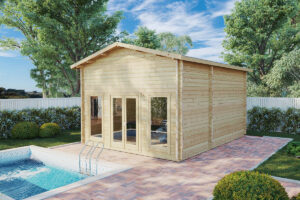
Golf Simulator Cabin 1 – 27 m², 6×4 m (70 mm): another option in the same range, built to house a complete golf simulator in a converted outdoor space.
You can browse the full range of garden golf simulator rooms and compare the different options based on your space and equipment needs.
Before installing a golf simulator cabin in the garden, it’s important to check that the available space and local regulations allow for the project. Beyond the size of the structure itself, you’ll need to consider location, access, and the space needed around the building for comfort and maintenance.
It’s also worth checking the required distance from boundary lines, as well as any municipal licences or permits. These requirements vary from one municipality to another, so it’s worth checking local planning regulations before you start. Proper planning avoids problems further down the line and helps ensure a golf room that’s functional, comfortable and suited to its surroundings.
You can find more information on the paperwork and legal aspects of installing a timber house or cabin in this guide to planning regulations for log cabins.
Planning these aspects before installation will help you avoid problems later and ensure your garden golf room is a functional, comfortable space that complies with local regulations.
Investing in your own golf space at home can be a high upfront cost. But, it can pay off in the long run once you factor in club membership fees, green fees and travel. On top of that, there’s the time saved and the convenience of being able to train whenever you like, whatever the weather, without being tied to opening hours or external conditions.
It also lets you analyse every swing in detail, improve your technique, and enjoy golf at home whenever you want. You can invite friends over any time and enjoy your favourite sport together, with no restrictions.
The cost of playing golf regularly adds up quickly. Playing a round at a renowned course like Real Club Valderrama can cost more than €500, while at other quality courses such as La Cala Resort green fees typically sit around €80–100 per round, depending on the season and booking conditions. For someone playing once a week, even at an average of €80 a round, the annual spend on green fees can exceed €4,000 – without counting travel, equipment or membership fees.
Compared with several years of club fees or practice sessions, a one-off investment in a cabin equipped as a golf simulator room can pay for itself within a few years for anyone who plays golf regularly.
Prices typically range from around €3,000 without a cabin to €40,000 with a sophisticated system and cabin included. The price of a home golf simulator depends on several factors: the launch monitor, screen, projector, software and any additional equipment. On top of that, you need to factor in the structure that houses it, such as an insulated garden cabin designed to provide the necessary space and height.
It depends on the location, the size of the structure and local regulations. Before installing a golf simulator cabin, it’s worth checking local planning requirements and whether you need a building licence or simply need to submit prior notice (comunicación previa).
The recommended size depends on the type of simulator and the space needed to swing comfortably. For a complete set-up, a cabin of around 6×4 m offers plenty of room for the technology as well as space to move freely.
Yes. The interior layout can be adapted to the simulation system you choose, including screen and projector placement, lighting, and any extra accessories. Planning the space from the outset makes the most of every available metre.
Installation time depends on the model chosen, groundwork, and any accessories included. Prefabricated timber cabins are quicker to install than a traditional build, and installation usually takes no more than 7 days.
Delivery time depends on the model. In-stock cabins are usually delivered within 3 to 4 weeks, while made-to-order models take 5 to 8 weeks. For a fully bespoke cabin, expect a lead time of around 8 to 12 weeks. Check the specific delivery time on each product page.
Yes, it’s possible to install heating or air conditioning so you can use the simulator all year round.
Build your own golf simulator room in the garden
A home golf room is a practical way to enjoy your passion for golf all year round, turning outdoor space into a dedicated area for training and leisure. With the right size, good insulation and a design suited to your needs, you can create a genuine private golf space at home.
Browse our full range of golf simulator cabins and find the model that best suits your project, or request a personalised quote to design a bespoke solution.
Sources: