If your garden shed sits in full sun, opt for a pigmented wood stain in a light or mid-tone shade, and use the 60-30-10 rule—dividing coverage between walls, trim, and accents—to create a well-balanced palette. If your shed is built from spruce, steer clear of clear wood stains altogether: without pigments to filter ultraviolet light, solar radiation will cause the timber to develop dark, patchy discolouration. Before committing, test a sample with the exact number of coats you intend to apply and evaluate it at different times of day, as stains deepen considerably with every layer.
| Your Situation | Recommended Finish | Why |
|---|---|---|
| Direct sunlight for most of the day | Light or mid-tone shade | Dark shades absorb more heat and fade noticeably faster |
| Spruce shed | Pigmented wood stain or opaque paint | Blocks UV rays from degrading the timber |
| Limited time for maintenance | High-quality semi-transparent stain | Can be reapplied down the line without sanding back to bare wood |
Remember that colour swatches appear far more saturated across a broad expanse of cladding and will shift as the sun moves across your garden. When in doubt, consulting a coatings specialist will help you choose the right finish for your microclimate.
We manufacture premium Nordic spruce garden sheds and supply compatible wood stains and protective treatments alongside your build. Choose your layout and finish in one straightforward order.
Direct from the manufacturer with over 20 years of experience and a 5-year warranty.
Paint cures into a solid, opaque film that conceals the wood grain beneath, along with any minor knots or cosmetic blemishes. It is the best route if you want a bold, uniform shade. For exterior timber, paint should always be applied as a full multi-stage system: an initial wood preservative or primer to prevent rot and fungal attack, an undercoat for uniform adhesion, and a durable exterior topcoat formulated to resist cracking and weathering.
Wood stain is a semi-transparent or translucent treatment that penetrates the timber, allowing the natural grain figure to remain visible. Stains range from subtle tints to high-pigment, semi-opaque varieties. Many professional exterior stains are multi-coat systems featuring an integrated base preservative and protective topcoat. Applying only a single thin coat is a common mistake: timber requires sufficient film build to resist water absorption, splitting, and seasonal movement.
Spruce outbuildings should never be treated with clear wood stain. As noted by Remmers, colourless stains provide virtually no UV protection and should only be used in sheltered, fully shaded settings such as the underside of deep eaves. Lignin in softwoods breaks down rapidly under UV exposure; pigments are essential to deflect solar radiation before it degrades the surface fibres. Naturally durable species like cedar and larch weather into a silver-grey patina and can tolerate clear topcoats far better than spruce.
Remmers recommends applying approximately 100 ml/m² per coat, with a minimum of two coats (smooth-planed or exceptionally dense timber may require three). For a standard 3 × 3 m shed with a wall height of 2 m, the total exterior wall area comes to roughly 24 m²—or around 20 m² once window and door openings are deducted. Applying two coats will require roughly 4 litres of stain; three coats will require around 6 litres. Always allow a margin for wood porosity. Very pale or lightly pigmented finishes offer less UV resistance and will need more frequent touch-ups over time.
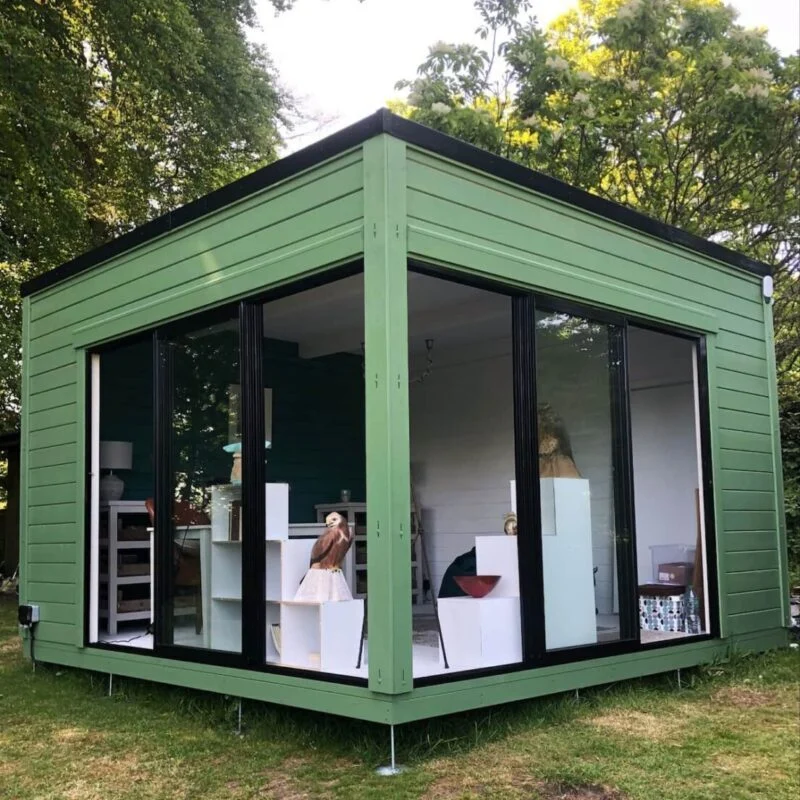
Warm tones lend an inviting, grounded feel to a garden, making them ideal for brightening shaded plots or complementing sun-soaked courtyards. Popular options include natural honey cedar, terracotta, sage green, warm stone grey, cream, and classic Swedish red. Keep in mind that deep warm colours can visually reduce the perceived size of a shed, and certain red pigments fade faster under intense sun.
Cool tones deliver a calm, contemporary finish that can make compact gardens feel larger and airier. Favourites include slate blue, seafoam, duck egg blue, dove grey, mint, and Nordic blue. It is worth noting that a colour’s Light Reflectance Value (LRV)—not whether it feels “warm” or “cool”—dictates how much heat it absorbs: a dark slate blue draws in just as much heat as a dark oxide red. Cool shades can also feel somewhat stark in dull winter light, and pale blues and greys will show splashes of garden mud sooner.

Neutral tones provide classic elegance that works alongside almost any garden design: clear-toned timber preservatives, warm off-whites, greige, taupe, limestone, and muted parchment.
Cool greys carry subtle blue or green undertones, while natural timber finishes function visually as warm yellows, oranges, and reds. Rather than painting an outbuilding in a single flat tone, you can add depth by combining coordinated shades across different structural elements.
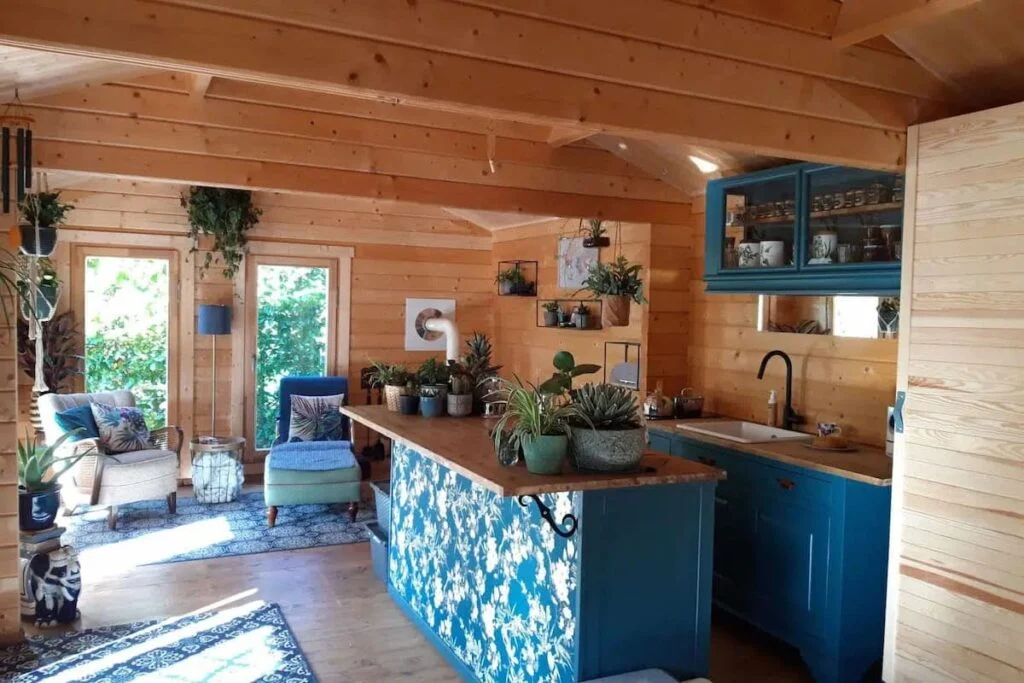
To keep your palette balanced, follow the 60-30-10 rule: apply your dominant colour across 60% of the surface (the main cladding walls), your secondary shade across 30% (fascias, window surrounds, and door frames), and reserve an accent shade for the remaining 10% (the entrance door, window shutters, or decorative planters). For inspiration on styling the inside of your space, see our guide on decorating a small log cabin.
Before opening a tin of paint, check any relevant local planning rules or community bylaws. In Spain, Article 7 of the Horizontal Property Act (Ley de Propiedad Horizontal) prohibits alterations to private property that modify the building’s external appearance or uniform architectural character without prior notification and approval from the community of owners. In addition, municipal planning guidelines—frequently published in regional official gazettes such as the BOCM—may require outbuildings and garden structures to complement the materials and palette of the main residential property. Check with your local planning department or residents’ committee before choosing an unconventional or bright colour scheme.
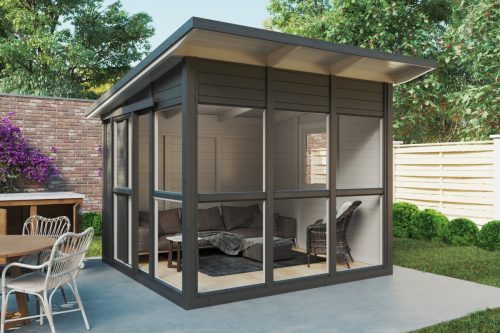
Deep charcoals, architectural blacks, and forest greens look exceptional on outbuildings with clean lines and floor-to-ceiling glass. Explore our range of garden sheds, featuring modern timber designs ready for protective treatment in the colour of your choice.
Free delivery included and backed by a 5-star Trustpilot rating.
Take your site’s sun exposure into account, choose a durable pigmented wood stain, and always test a sample on-site before starting. You can order a complete, professional timber treatment system alongside your shed purchase, available in an extensive selection of finishes from natural wood tones and earthy greens to striking contemporary greys.
No. Clear stains lack the protective pigments needed to block UV rays. Unfiltered sunlight breaks down the timber’s surface fibres, causing spruce to develop dark, patchy discolouration. Always use a pigmented stain or opaque exterior paint; save clear finishes for naturally durable timbers like cedar or larch.
Most quality stains need refreshing every 2 to 5 years, depending on product formulation, pigment density, and exposure to sun and rain. South-facing elevations, dark shades that absorb high heat, and budget stains will require maintenance sooner.
Pale, light-reflective shades—such as warm off-white, dove grey, mint, or soft sky blue—reflect light and help the structure feel more open and spacious. Very dark tones absorb light and make structures appear more compact, making them better suited to trim or larger contemporary studios.